
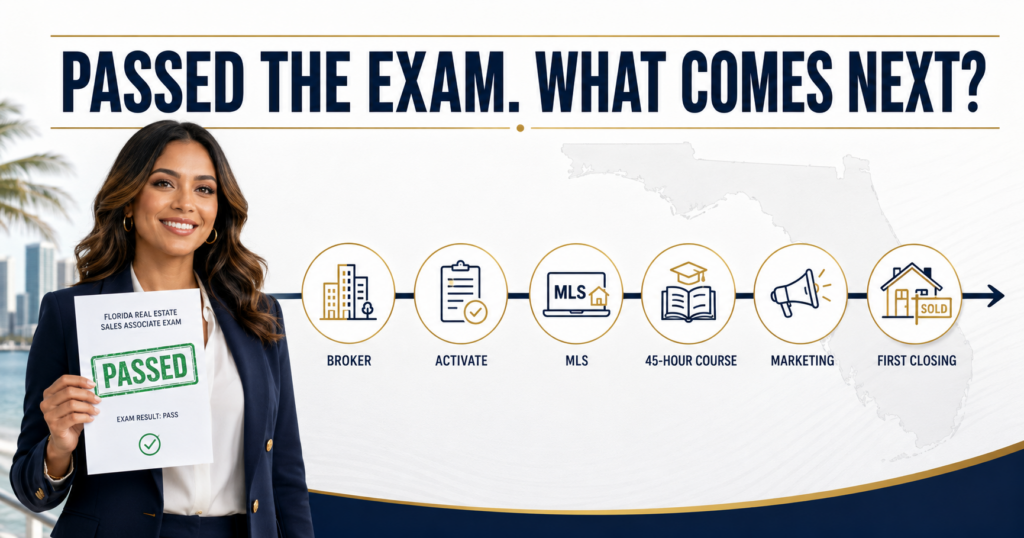
Your step-by-step guide to activating your license, choosing a broker, completing post-license education, and starting your career
TL;DR: After passing the Florida real estate exam, verify your DBPR license record, choose a brokerage, make sure your license is registered with that brokerage before performing real estate services, and begin learning the brokerage’s systems. You should also schedule your required 45-hour post-license education well before your first renewal deadline. MLS access, REALTOR® membership, marketing tools, and business systems may come next, but they do not replace the state licensing requirements.
You Passed the Exam—Now What?
Passing the Florida real estate exam is a major accomplishment. You completed your pre-license education, navigated the application process, prepared for a demanding test, and earned a passing score. However, passing the exam is the beginning of your career—not the end of the licensing process.
After passing the Florida real estate exam, your next decisions will affect how quickly, confidently, and legally you can begin working. First, you need to confirm your license record. Next, you must select a broker and establish the proper license relationship. Then you can learn the systems, tools, and daily practices used in real transactions.
If you are still working through the licensing process, review Florida Real Estate License Requirements: Steps, Costs & How to Get Licensed for a complete overview.
1. Verify Your License Record with DBPR
First, confirm that the Florida Department of Business and Professional Regulation (DBPR) has updated your license record. Passing the examination does not mean you should immediately begin showing properties, advertising services, or negotiating transactions.
Use the DBPR license search or your online account to verify your license number, status, expiration date, mailing information, and brokerage relationship. If any information appears incorrect, contact DBPR or work with your broker to correct it before conducting licensed activity.
Important: Do not rely only on an email, exam score report, or brokerage welcome message. Confirm the status displayed in the official DBPR record.
2. Choose a Florida Real Estate Brokerage
A Florida sales associate performs real estate services under the direction, control, or management of a broker. Therefore, choosing a brokerage is more than finding a place to hold your license. It determines who will supervise your work, review your transactions, establish office procedures, and help you handle questions involving contracts, advertising, disclosures, and escrow.
Although commission splits matter, they should not be your only consideration. A high split may provide little value if the brokerage offers limited training, weak broker access, or expensive add-on services.
Before making a decision, compare:
- New-agent training and transaction support
- Access to the broker, manager, or mentor
- Commission splits and transaction fees
- Monthly, technology, franchise, marketing, or desk fees
- Lead-generation programs and referral-fee arrangements
- Customer relationship management and transaction platforms
- Office culture, expectations, and accountability
- Requirements for REALTOR® association or MLS membership
For a deeper interview guide, read What Do Florida Brokers Want From New Real Estate Agents?.
3. Register Your License with the Brokerage
Once you select a brokerage, the appropriate brokerage representative must establish your license relationship with the company. DBPR provides an online process for adding a sales associate to a brokerage relationship, and the RE 11 transaction is also used when a sales associate or broker sales associate wishes to become active with a real estate company.
After the relationship is submitted, verify the change in the DBPR system. Your record should show the correct employing broker or brokerage before you perform real estate services. Florida’s online licensing information also explains that only one active relationship can exist between a brokerage and a sales associate at a time.
In other words, passing the state exam gives you the credential, but your properly registered brokerage relationship gives you the legal framework in which to practice as a sales associate.
4. Complete Brokerage Onboarding
Next, learn how your brokerage operates. Even if you understand Florida license law, every brokerage has its own policies, approved forms, marketing rules, transaction procedures, technology, and risk-management systems.
Your onboarding should explain:
- Who reviews contracts and when approval is required
- How transaction documents are submitted and stored
- Which forms and contract versions the brokerage authorizes
- How advertising and social media content must identify the brokerage
- How leads, referrals, commissions, and fees are handled
- Whom to contact when a legal, ethical, escrow, or transaction question arises
- What training, mentoring, and office meetings are available
Most importantly, ask questions before you act. Your broker would rather answer a question early than correct a preventable mistake after a contract has been signed.
5. Decide Which Professional Memberships and Tools You Need
Meanwhile, determine which memberships and tools are required by your brokerage or local market. A Florida real estate license does not automatically make you a REALTOR®. REALTOR® is a membership designation associated with the National Association of REALTORS®, and membership requirements may involve local, state, and national associations.
Likewise, passing the exam does not automatically provide MLS or electronic lockbox access. Your brokerage and local MLS can explain eligibility, applications, fees, training, and access rules.
Before paying for anything, ask your brokerage which services are included and which you must purchase separately. Possible expenses include:
- Association dues and MLS fees
- Electronic lockbox access
- Errors and omissions insurance
- Transaction-management or CRM software
- Professional photography or marketing services
- Business cards, signs, name badges, and other approved materials
6. Build Your Basic Business Systems
After your brokerage relationship and required tools are in place, begin operating like a business owner. Real estate may offer flexibility, but success requires structure, consistent follow-up, and accurate records.
Start with a simple foundation:
- Create a weekly schedule for training, prospecting, appointments, and follow-up.
- Organize a contact database and obtain permission before sending marketing communications.
- Set a realistic budget for dues, technology, marketing, transportation, and education.
- Use brokerage-approved email signatures, social media profiles, and advertising templates.
- Track income and business expenses, and consult a qualified tax professional when needed.
- Set activity goals you can control, such as conversations, follow-ups, open houses, and appointments.
At this stage, your first goal is not to look like an experienced top producer. Instead, focus on developing reliable habits and learning how to serve customers accurately and professionally.
7. Begin Your 45-Hour Post-License Education Early
One of the most important steps after passing the Florida real estate exam is planning for your first license renewal. Florida sales associates must complete 45 hours of Commission-approved post-license education before the first renewal following initial licensure. DBPR also requires the applicable renewal fee.
Do not confuse the 45-hour post-license requirement with the 14-hour continuing education requirement that applies to later renewal periods. They are different requirements for different stages of your career.
If a sales associate does not complete the required post-license education before the first renewal deadline, Florida law provides that the license becomes null and void. To operate again, the person must requalify by completing the sales associate pre-license course and passing the state licensing examination again. Because the consequence is serious, check the expiration date on your license and finish the course early.
Learn more in the Florida Real Estate 45-Hour Post-License Course: First Renewal Guide.
Best practice: Enroll early enough to complete the lessons, prepare for the end-of-course examination, and resolve any reporting issue before your license expires.
8. Create a Practical First-30-Day Plan
Finally, turn your excitement into action. A simple 30-day plan can keep you from spending your first month buying tools without building skills or relationships.
- Week 1: Confirm your license status, complete brokerage registration, attend orientation, and identify your primary broker or mentor contact.
- Week 2: Learn the brokerage’s contracts, transaction process, advertising rules, CRM, MLS procedures, and document-storage system.
- Week 3: Organize your contact database, prepare a compliant introduction, practice buyer and seller conversations, and schedule daily prospecting time.
- Week 4: Shadow an experienced agent, attend an inspection or closing when permitted, help with an open house, and review your progress with your broker.
The purpose of this plan is not to master real estate in four weeks. Instead, it is to create momentum while keeping your broker involved in your development.
Common Mistakes to Avoid After Passing the Exam
- Performing or advertising real estate services before confirming the correct active brokerage relationship
- Choosing a brokerage based only on the commission split
- Buying memberships or software before learning what the brokerage provides
- Assuming the brokerage will automatically provide enough leads to build a business
- Waiting until the renewal month to begin the 45-hour post-license course
- Using unapproved advertising, forms, or social media content
- Guessing when a contract, disclosure, escrow, or legal question should be taken to the broker
Your After-the-Exam Checklist
- Verify your license record and expiration date with DBPR.
- Interview and select a Florida real estate brokerage.
- Confirm that DBPR shows the correct brokerage relationship.
- Complete the brokerage’s orientation and required training.
- Ask about REALTOR® membership, MLS access, lockbox access, and related costs.
- Set up brokerage-approved business and marketing systems.
- Create a weekly prospecting, training, and follow-up schedule.
- Enroll in the 45-hour post-license course well before your first renewal.
- Ask your broker for guidance whenever you are unsure.
Frequently Asked Questions
Can I work immediately after passing the Florida real estate exam?
Do not perform real estate services until your license record shows the appropriate status and your relationship with the employing brokerage has been established. Confirm your information through DBPR and with your broker before beginning licensed activity.
Do I have to join a REALTOR® association?
A state real estate license and REALTOR® membership are not the same. Membership requirements depend on the brokerage, local association, and services you plan to use. Ask the brokerage and local organization what applies to you.
Does passing the exam give me MLS access?
No. MLS access is separate from state licensure. Eligibility, fees, training, and access procedures vary by brokerage and local MLS.
When is the 45-hour post-license course due?
It must be completed before the expiration date associated with your first renewal following initial licensure. Check your DBPR record for the exact date and complete the course early.
What happens if I miss the post-license deadline?
Under Florida law, a sales associate’s license becomes null and void if the required post-license education is not completed before the first renewal. Requalification requires completing the pre-license course again and passing the state examination again, subject to any applicable hardship provision or exemption confirmed by DBPR.
Final Thoughts
Passing the Florida real estate exam proves that you understand the foundation. What you do next determines how effectively you turn that knowledge into a professional career.
Verify your license, choose a supportive broker, learn the brokerage’s systems, build disciplined business habits, and complete your post-license education early. With those steps in place, you can begin serving customers with greater confidence while protecting the license you worked hard to earn.
Ready to Take the Next Step?
Explore Florida real estate courses at OLTraining.com and choose the education that matches the next stage of your career.
Official Resources
- Florida Department of Business and Professional Regulation
- DBPR Become Active information
- DBPR license search
- Chapter 475, Florida Statutes
Licensing requirements can change. Verify current requirements and deadlines with DBPR and FREC before relying on this educational article.
Tags: Florida Real Estate Exam, Florida Real Estate License, New Florida Real Estate Agent, Florida Real Estate Broker, License Activation, Florida Post-License Education, 45-Hour Post-License Course, DBPR, FREC, MLS Access, Real Estate Career Tips