
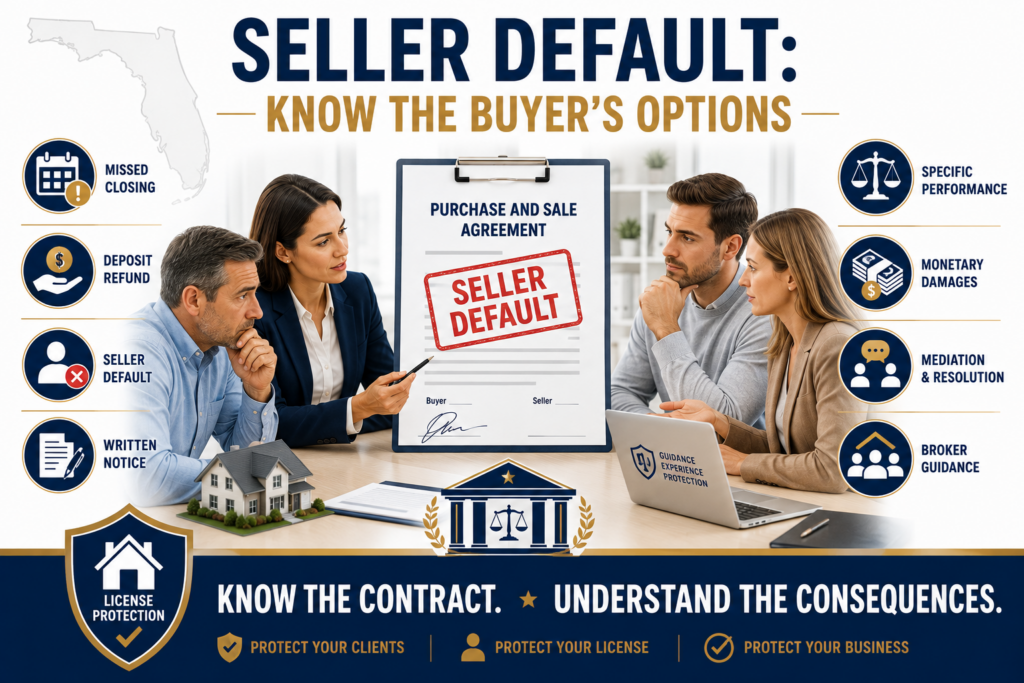
What new Florida real estate agents should know when a seller refuses to close, fails to perform, or tries to back out of a residential sales contract.
TL;DR
A Florida seller contract breach may occur when a seller fails, neglects, or refuses to perform an obligation required by a valid real estate purchase contract without a contractual or legal excuse.
Depending on the contract, a buyer may be able to recover the escrow deposit, seek damages, pursue specific performance to force the sale, or negotiate a release and settlement. A seller generally cannot simply change their mind because they received a better offer, decided not to move, or no longer like the terms they previously accepted.
However, not every failed transaction is a seller breach. The contract may contain contingencies, title provisions, extensions, or other terms that excuse or delay the seller’s performance.
For agents, the most important steps are to review the signed contract, notify the broker, document everything, avoid giving legal advice, and recommend that the parties consult a Florida real estate attorney when their rights are disputed.
What Is a Florida Seller Contract Breach?
A residential purchase and sale contract creates obligations for both the buyer and seller.
A Florida seller contract breach can occur when the seller fails to perform an obligation required by the contract without a valid contractual or legal reason.
Possible examples include a seller who:
- Refuses to close after signing a binding contract
- Refuses to sign required closing documents
- Attempts to sell the property to another buyer
- Fails to provide required documents
- Fails to perform an agreed contractual obligation
- Refuses to provide possession as required
- Intentionally prevents the transaction from closing
- Fails to satisfy an obligation that was necessary for closing
- Attempts to cancel simply because a better offer appears
Whether a particular action actually constitutes a breach depends on the exact contract language and facts of the transaction.
Therefore, a real estate agent should never make the final legal determination that a seller is in breach.
Can a Florida Seller Just Change Their Mind?
One of the most common questions new agents hear is:
“The seller changed their mind. Can they just cancel?”
Once the seller has entered into a binding sales contract, the answer is usually not simply yes.
A seller generally does not receive an unrestricted right to cancel merely because:
- The seller no longer wants to move
- The seller cannot find another home
- The seller believes the sale price is too low
- Another buyer offers more money
- Family members object to the sale
- The seller becomes emotionally attached to the property
- The seller regrets accepting the offer
The seller’s ability to terminate depends on the contract.
If the contract contains a seller contingency or another applicable termination provision, the seller may have a valid right to cancel.
Without such a provision, refusing to perform may create a Florida seller contract breach.
A Failed Closing Is Not Always a Seller Breach
Not every transaction that fails to close involves wrongdoing by the seller.
For example, a contract may provide additional time or termination rights involving:
- Title defects
- Casualty damage
- Condemnation
- Buyer default
- Financing
- Association matters
- Contract contingencies
- Governmental requirements
- Force majeure events
- Other negotiated provisions
One especially important example involves title.
Under commonly used Florida residential contracts, a seller may receive time to correct certain title defects.
If the seller makes the contractually required diligent effort but cannot make title marketable within the applicable provisions, the failure may not constitute seller default.
That is why agents must read the contract rather than assuming that every delayed or canceled closing equals breach.
The Contract Form Matters
Florida transactions may use several different contracts, including:
- Florida Realtors/Florida Bar AS IS Residential Contract for Sale and Purchase
- Florida Realtors/Florida Bar Residential Contract for Sale and Purchase
- Florida Realtors Contract for Residential Sale and Purchase
- Builder or developer contracts
- Attorney-prepared contracts
The default provisions are not necessarily identical.
Therefore, when a potential Florida seller contract breach occurs, review:
- The exact contract form
- Revision date
- Riders
- Addenda
- Seller obligations
- Buyer obligations
- Closing date
- Title provisions
- Default provisions
- Notice requirements
- Dispute-resolution provisions
- Attorney-fee provisions
Never assume that the remedy from one transaction automatically applies to another.
What Happens to the Buyer’s Escrow Deposit?
If the seller breaches the contract, the buyer may be entitled to the return of the escrow deposit.
Under the commonly used Florida Realtors/Florida Bar contract, the buyer may elect to receive the deposit back without automatically giving up a claim for damages resulting from the seller’s breach.
That distinction is extremely important.
Returning the deposit does not necessarily mean that all issues between the parties have been resolved.
The buyer may still have other contractual remedies.
Can the Buyer Recover Damages?
Depending on the contract and circumstances, a buyer may seek monetary damages following a seller breach.
Possible claims may involve money the buyer spent while preparing to purchase the property.
Examples could include:
- Inspection expenses
- Title examination expenses
- Survey expenses
- Financing-related expenses
- Appraisal costs
- Other qualifying transaction expenses
Florida law concerning damages in real estate contract disputes can become complicated.
The amount a buyer may recover can depend on issues such as:
- Whether the buyer was ready, willing, and able to perform
- Whether the seller acted in good faith
- Whether the seller acted in bad faith
- Whether the property was sold to another party
- The language of the contract
- The actual losses suffered
Real estate agents should never calculate damages or promise a buyer that a particular expense will be recovered.
That is a matter for legal counsel.
What Is Specific Performance?
Specific performance is one of the most important concepts new Florida agents should understand when discussing seller default.
Instead of asking only for money, the buyer may ask a court to require the seller to perform the contract.
In practical terms, the buyer may be asking the court to:
Make the seller sell the property according to the agreement.
Real estate is considered unique, which is one reason specific performance can be an available remedy in real estate disputes.
Can a Buyer Really Force a Seller to Sell?
Potentially, yes.
If the buyer has a valid enforceable contract and satisfies the requirements for specific performance, a court may order the seller to convey the property.
However, this remedy is not automatic.
Among other issues, a buyer seeking specific performance may need to establish that the buyer:
- Had a valid contract
- Performed required contractual obligations
- Was ready, willing, and able to close
- Was entitled to enforcement of the agreement
Specific performance litigation can be expensive and time-consuming.
Agents should never tell a buyer:
“We can force the seller to close.”
A better response is:
“The contract may provide legal remedies, including the possibility of specific performance. You should discuss your options with a Florida real estate attorney.”
Why Specific Performance Can Create Serious Problems for the Seller
A specific performance dispute can create problems that extend far beyond the original transaction.
If a buyer files a lawsuit seeking ownership of the property, the seller may have difficulty selling or transferring clear title while the dispute remains unresolved.
A pending lawsuit involving ownership rights may also complicate:
- Title insurance
- Future offers
- Refinancing
- Property transfers
- Subsequent closings
For this reason, a seller should obtain legal advice before attempting to sell the property to someone else after a dispute develops with the original buyer.
What If the Seller Gets a Better Offer?
Imagine this situation:
A seller accepts a $450,000 offer.
Two days later, another buyer offers $475,000.
The seller tells the listing agent:
“Cancel the first contract. I want the higher offer.”
This creates a serious problem.
A better offer does not automatically give the seller the right to cancel an existing binding contract.
If the seller refuses to honor the first contract, the original buyer may have contractual remedies.
The listing agent should:
- Notify the broker immediately
- Review the signed contract
- Avoid telling the seller that the first agreement can simply be canceled
- Recommend legal counsel
- Continue following lawful broker instructions
The existence of a higher offer does not erase the first contract.
What If the Seller Decides Not to Move?
This is another common situation.
A seller may decide:
- Their replacement home costs too much
- Interest rates changed
- Their employment situation changed
- Their family circumstances changed
- They simply want to remain in the property
Those concerns may be understandable.
However, personal circumstances do not automatically create a contractual cancellation right.
If the seller wanted the sale to depend on purchasing another property, that condition ordinarily needed to be addressed in the sales contract.
This is why contingencies should be considered before the contract is executed—not after problems arise.
Can the Buyer Recover the Deposit and Still Sue?
Under the commonly used Florida Realtors/Florida Bar AS IS contract, potentially yes.
The seller-default provision allows the buyer to elect to receive the buyer’s deposit back without thereby waiving an action for damages resulting from the seller’s breach.
The buyer may also be able to seek specific performance according to the contract’s dispute-resolution provisions.
This differs significantly from certain buyer-default provisions where the seller may elect to retain a deposit as liquidated damages in full settlement of contractual claims.
New agents should understand this distinction.
Mediation May Come Before Court
Many Florida residential contracts contain dispute-resolution provisions requiring the parties to attempt mediation before pursuing most litigation.
Mediation involves a neutral third party who helps the buyer and seller attempt to reach an agreement.
The mediator does not impose the outcome.
Instead, the parties decide whether to settle.
Possible settlements might include:
- Returning the buyer’s deposit
- Reimbursing buyer expenses
- Paying an agreed settlement amount
- Extending the closing date
- Modifying contract terms
- Completing the original sale
- Releasing both parties from further obligations
Many disputes can be resolved without a trial if the parties reach a mutually acceptable settlement.
Could the Seller Have to Pay Attorney’s Fees?
Potentially.
Some Florida residential contracts contain provisions allowing the prevailing party in permitted litigation to recover reasonable attorney’s fees and costs.
This means a dispute involving a relatively small transaction issue could eventually become much more expensive.
Legal expenses are one reason agents should encourage parties to obtain qualified legal advice before taking actions that could escalate a disagreement.
Could the Seller Still Owe a Real Estate Commission?
Possibly.
The purchase contract and the listing agreement are separate contracts.
A seller who refuses to close may still have contractual obligations to the listing brokerage.
Many listing agreements provide that brokerage compensation is earned when the broker produces a buyer who is ready, willing, and able to purchase the property on terms acceptable to the seller.
Therefore, stopping the sale does not necessarily eliminate the seller’s obligation to compensate the brokerage.
The exact result depends on the listing agreement.
Agents should refer commission disputes to the broker.
Can the Seller Sell the Property to Someone Else?
This can be extremely risky while the first contract remains unresolved.
A seller should not assume:
“If I return the deposit, the contract is over.”
Returning or offering to return the deposit does not necessarily give the seller the unilateral right to terminate a valid purchase contract.
Before accepting or closing with another buyer, the seller should determine whether the first agreement has been properly terminated.
The seller should obtain guidance from:
- The listing broker
- The title professional
- A Florida real estate attorney
Otherwise, the seller could create competing contractual claims involving the same property.
What Should the Buyer’s Agent Do?
If a seller appears unwilling to perform, the buyer’s agent should:
- Notify the broker.
- Review the signed contract and all addenda.
- Identify the seller obligation involved.
- Confirm relevant deadlines.
- Document all communications.
- Continue helping the buyer satisfy the buyer’s own obligations.
- Avoid declaring the seller legally in default.
- Avoid promising damages or specific performance.
- Recommend that the buyer obtain legal advice.
- Deliver authorized notices promptly.
One of the most important points is that the buyer should continue performing required obligations unless properly advised otherwise.
A buyer does not want to weaken a potential claim by creating a separate buyer default.
What Should the Listing Agent Do?
When a seller says they will not close, the listing agent should:
- Notify the broker immediately.
- Review the contract.
- Ask why the seller wants to cancel.
- Determine whether a contractual provision may apply.
- Document the seller’s instructions.
- Avoid providing legal advice.
- Avoid preparing unauthorized cancellation language.
- Recommend that the seller consult an attorney.
- Communicate professionally with the cooperating agent.
- Confirm contract termination before treating the property as freely available.
The listing agent should not become an advocate for breaching the contract.
The agent’s job is to help the seller understand the transaction, follow broker instructions, and obtain appropriate professional guidance.
What Agents Should Never Say
Avoid statements such as:
- “You can cancel because you are the seller.”
- “Just give the buyer the deposit back.”
- “The buyer cannot force you to sell.”
- “Take the higher offer instead.”
- “The contract is automatically canceled.”
- “Specific performance never happens.”
- “Just refuse to sign at closing.”
- “We can relist immediately.”
- “The buyer can only get their deposit back.”
- “There is nothing the buyer can do.”
These statements may be incorrect and could increase the legal exposure of the seller, agent, and brokerage.
Can the Parties Still Save the Transaction?
Yes.
A potential Florida seller contract breach does not always have to become a lawsuit.
The parties may agree to modify the transaction.
Possible solutions include:
- Extending the closing date
- Allowing additional time for the seller to move
- Creating a post-closing occupancy agreement
- Modifying the purchase price
- Resolving a title issue
- Adjusting closing costs
- Changing possession terms
- Addressing repairs
- Negotiating another written amendment
- Mutually terminating the transaction
Any agreement changing the contract should be documented in writing and properly executed.
Why Documentation Matters
Seller-default disputes often depend on the exact timeline.
Agents should maintain records showing:
- When the contract was executed
- When deposits were made
- When inspections occurred
- When financing deadlines passed
- When title issues were discovered
- What notices were delivered
- What the seller instructed
- What the buyer communicated
- Whether extensions were requested
- Whether amendments were signed
- Whether the parties remained ready to close
Important documentation may include:
- The sales contract
- Riders
- Addenda
- Emails
- Text messages
- Transaction notes
- Title documents
- Closing communications
- Inspection records
- Written notices
- Cancellation forms
- Release agreements
Good documentation helps brokers and attorneys understand what happened.
Florida Seller Contract Breach Checklist for New Agents
- Review the signed contract.
- Check all amendments and riders.
- Confirm the closing date.
- Determine which seller obligation is involved.
- Check whether the buyer has performed.
- Review title provisions.
- Review default provisions.
- Review dispute-resolution requirements.
- Notify your broker.
- Preserve all communications.
- Do not give legal advice.
- Recommend an attorney.
- Do not promise a particular remedy.
- Do not assume the deposit resolves everything.
- Do not relist as though the first contract disappeared without confirming its status.
Continue Learning
Understanding seller default is one part of learning how Florida residential transactions work in practice.
You may also find these resources helpful:
- What Happens When a Buyer Breaches a Florida Real Estate Contract?
- AS IS vs. Standard Florida Residential Contract
- Florida Real Estate Disclosures: Complete Guide
- Can a Florida Real Estate Agent Be Personally Sued?
- Florida Real Estate Exam vs. Real-World Practice
Final Thoughts
A Florida seller contract breach can create serious consequences for sellers, buyers, agents, and brokers.
A seller who refuses to perform may face more than simply returning the buyer’s deposit.
Depending on the contract and circumstances, the buyer may seek:
- Return of the deposit
- Monetary damages
- Reimbursement of qualifying expenses
- Specific performance
- Attorney’s fees and costs when authorized
The seller may also have separate obligations under the listing agreement.
However, agents should remember that not every failed closing is a breach.
The correct questions are:
- What does the signed contract require?
- Did the seller actually fail to perform?
- Did the seller have a contractual excuse?
- Has the buyer fulfilled the buyer’s obligations?
- What remedies does the contract provide?
- What dispute-resolution procedure applies?
When a dispute develops, the safest course for a new agent is to review the contract, involve the broker immediately, document every step, and recommend legal counsel.
Knowing where your role ends is just as important as knowing what the contract says.
Ready to Take the Next Step?
Continue building your Florida real estate knowledge with professional licensing, exam preparation, post-licensing, and continuing education courses.
Educational Notice: This article provides educational information and is not legal advice. Contract rights and remedies depend on the signed agreement and facts of the transaction. Buyers, sellers, and licensees should consult a Florida real estate attorney when legal rights are disputed.
Tags: Florida Seller Contract Breach, Seller Default Florida Real Estate, Florida Real Estate Contract, Specific Performance Florida, Seller Refuses to Close, Florida Real Estate Agents, Florida Escrow Deposit, Real Estate Contract Default