
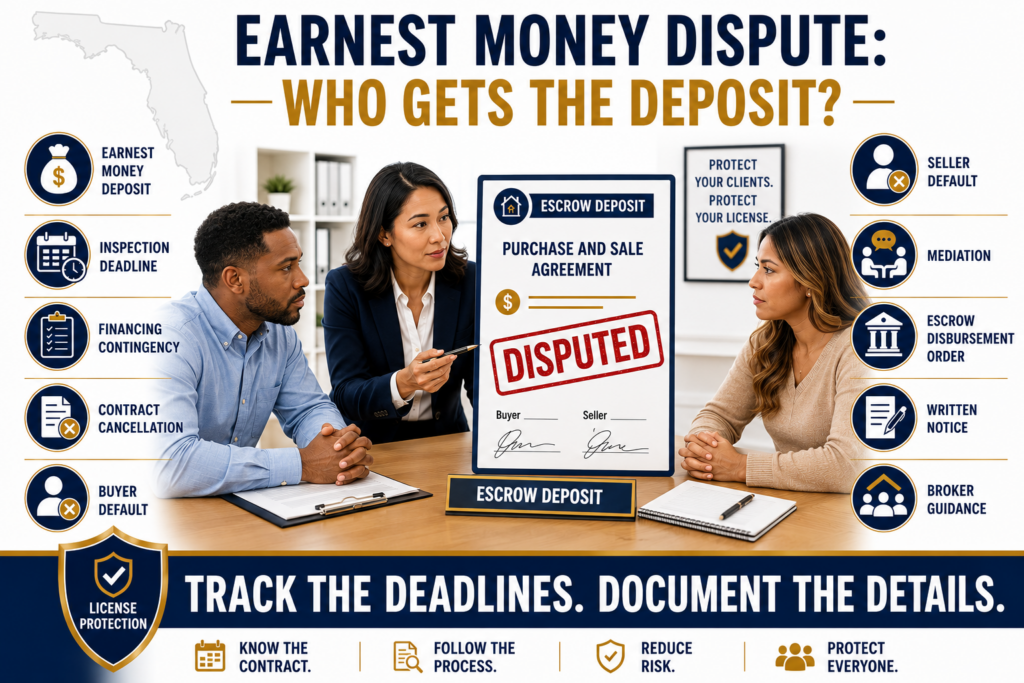
How earnest money disputes happen in Florida real estate transactions—and what new agents can do to help prevent them.
TL;DR
Florida earnest money disputes usually occur when a real estate transaction ends and the buyer and seller disagree about who should receive the escrow deposit.
Common causes include missed inspection deadlines, financing problems, buyer or seller default, disagreement about cancellation rights, title problems, improperly delivered notices, and unclear contract terms.
The escrow holder cannot simply decide who deserves the money because one party demands it. The process depends on the contract, who holds the deposit, and Florida escrow law.
New agents can reduce the likelihood of disputes by understanding contract deadlines, confirming deposits are delivered on time, documenting notices, identifying the escrow agent clearly, involving the broker early, and never promising a buyer or seller that they will automatically receive the deposit.
What Is Earnest Money?
Earnest money is a deposit a buyer agrees to make as part of a real estate purchase contract.
It is also commonly called:
- An earnest money deposit
- An escrow deposit
- A good-faith deposit
- The deposit
The purchase contract normally identifies:
- The amount of the deposit
- When it must be delivered
- Who will hold it
- Whether an additional deposit is required
- How the deposit will be applied at closing
- What may happen to the deposit if the transaction does not close
If the transaction closes, the deposit is normally credited toward the buyer’s purchase price and closing obligations.
Problems arise when the transaction does not close.
Then everyone wants to know:
Who gets the earnest money?
That question is the source of many Florida earnest money disputes.
Why Earnest Money Does Not Automatically Belong to Either Party
One of the biggest mistakes new agents make is assuming that a failed transaction automatically determines who receives the deposit.
For example:
“The buyer canceled, so the seller gets the deposit.”
Or:
“The closing didn’t happen, so the buyer gets the money back.”
Neither statement is automatically correct.
The answer depends on factors such as:
- The contract being used
- Why the transaction failed
- Whether a cancellation right existed
- Whether notice was delivered correctly
- Whether deadlines were met
- Whether the buyer or seller defaulted
- Whether another contingency applied
- Who is holding the escrow deposit
- Whether both parties agree to its release
Therefore, agents should never promise a particular outcome before reviewing the contract and discussing the situation with their broker.
How Florida Earnest Money Disputes Begin
Most disputes do not begin with an argument about money.
Instead, something happens during the transaction.
The buyer may want to cancel.
The seller may disagree.
The seller may refuse to close.
Financing may fall apart.
A deadline may be missed.
Eventually, both parties claim that the contract supports their position.
Then each party demands the deposit.
At that point, what started as a contract problem becomes an escrow dispute.
Inspection Period Disputes
Inspection periods are a frequent source of Florida earnest money disputes.
Under the commonly used Florida Realtors/Florida Bar AS IS contract, the buyer has a significant cancellation right during the inspection period.
However, timing matters.
Imagine this situation:
The inspection period expires Monday at 5:00 p.m.
The buyer decides Monday evening that they no longer want the property.
The cancellation notice is sent Tuesday morning.
The seller may argue that the cancellation right had already expired.
The buyer may believe the inspection findings justified cancellation.
Now the parties disagree about who is entitled to the deposit.
How Agents Can Help Prevent This
Agents should:
- Calendar the inspection deadline immediately.
- Confirm how the contract calculates time.
- Remind the buyer before the deadline.
- Obtain written instructions from the buyer.
- Deliver cancellation notices promptly.
- Keep evidence showing when notice was delivered.
A valid contractual right can be lost if the required notice is delivered too late.
Financing Contingency Disputes
Financing problems are another common source of escrow disputes.
A buyer may believe:
“My loan was denied, so I automatically get my deposit back.”
However, financing clauses usually contain requirements the buyer must satisfy.
Depending on the contract, the buyer may be required to:
- Apply for financing on time
- Provide accurate financial information
- Pay required lender fees
- Provide documents requested by the lender
- Use good-faith and diligent effort
- Obtain loan approval within applicable deadlines
- Deliver required notices on time
If financing fails despite the buyer properly complying with the contract, the buyer may have a valid contractual basis for recovering the deposit.
However, if the buyer stopped cooperating with the lender or missed a required notice deadline, the seller may dispute the buyer’s claim.
That is how a financing problem can become an earnest money dispute.
Appraisal Problems
A low appraisal does not automatically give every buyer the right to cancel.
The result depends on:
- The financing provision
- Any appraisal contingency
- Any appraisal-gap addendum
- The loan program
- Other contract language
For example, suppose a home is under contract for $500,000 but appraises for $470,000.
The buyer may want to cancel and receive the deposit back.
However, the seller may argue that the buyer agreed to cover an appraisal gap or that the contract did not provide the cancellation right the buyer is claiming.
Agents should never assume that “low appraisal equals deposit refund.”
Instead, review the actual contract.
Buyer Default
A Florida earnest money dispute may also arise when the seller believes the buyer defaulted.
Possible buyer defaults may include:
- Failing to make the deposit
- Failing to make an additional deposit
- Failing to pursue financing as required
- Refusing to close
- Failing to deliver closing funds
- Missing required contractual deadlines
- Abandoning the transaction without a cancellation right
Under commonly used Florida residential contracts, the seller may have remedies involving the deposit when the buyer defaults.
However, the agent should not declare:
“The seller gets the earnest money.”
The buyer may dispute whether a default actually occurred.
Once conflicting demands exist, the escrow holder must follow the appropriate dispute process.
Seller Default
Earnest money disputes can also occur when the seller fails to perform.
Examples may include a seller who:
- Refuses to close
- Accepts another offer and attempts to cancel the first contract
- Refuses to sign closing documents
- Fails to satisfy required contractual obligations
- Attempts to terminate without a contractual right
In a seller-default situation, the buyer may seek return of the deposit and may have other contractual remedies.
Therefore, returning the earnest money does not necessarily resolve every issue between the buyer and seller.
For more information, see:
Florida Seller Contract Breach: What Happens Next?
Title Problems
Title defects can also create disputes.
Examples may include:
- Unreleased liens
- Ownership disputes
- Probate issues
- Judgment liens
- Boundary problems
- Recorded restrictions
- Unresolved mortgages
- Other defects affecting marketable title
Florida residential contracts typically provide procedures and time periods for handling title defects.
If the seller is unable to correct the problem after making the required effort, the contract may provide the buyer with a right to terminate and recover the deposit.
However, if the parties disagree about whether the title defect was corrected or whether termination was proper, an escrow dispute may follow.
Condominium and HOA Cancellation Rights
Some transactions include statutory cancellation rights involving condominium or homeowners’ association documents and disclosures.
A buyer who properly exercises an applicable statutory cancellation right may be entitled to a deposit refund.
However, disputes can arise over questions such as:
- When documents were delivered
- Which documents were provided
- Whether delivery was complete
- When the cancellation period began
- Whether the buyer canceled on time
This is why document delivery should always be carefully tracked.
The Problem With Verbal Cancellations
A buyer calls the agent and says:
“I’m done. Tell them I’m canceling.”
The agent calls the listing agent.
No written notice is delivered.
Several days later, the parties disagree about whether the buyer properly terminated the contract.
This is exactly the type of situation that can turn into a deposit dispute.
Important notices should be delivered in the manner required by the contract.
Agents should document:
- The buyer’s or seller’s instructions
- When notice was prepared
- When notice was delivered
- Who received it
- How it was delivered
When deadlines matter, documentation becomes extremely important.
Do Not Leave the Escrow Agent Blank
The contract should clearly identify who will hold the earnest money.
This may be:
- A real estate broker
- A title company
- An attorney
- Another authorized escrow agent
Leaving the escrow agent listed as “TBD” can create unnecessary problems.
If the contract requires a buyer to deliver a deposit but does not clearly identify where the money must be delivered, disputes can arise over whether the buyer complied.
A small blank in the contract can create a very large problem later.
Confirm That the Deposit Was Actually Made
Never assume that because the contract says a deposit is due, the deposit was actually received.
Agents should distinguish between:
Deposit required by the contract
and
Deposit actually received by the escrow holder
If a buyer is required to deliver $10,000 within three days, the transaction file should eventually contain confirmation that the deposit was received.
This becomes particularly important when a title company or attorney holds the funds.
A missing deposit discovered shortly before closing can create major problems.
Who Is Holding the Earnest Money Matters
The dispute process differs depending on who holds the funds.
This is one of the most important concepts new Florida agents should understand.
When a Florida Real Estate Broker Holds the Deposit
If the broker receives conflicting demands for escrow funds held in the broker’s escrow account, Florida law and FREC rules apply.
The broker must follow specific notice and dispute-resolution procedures.
The sales associate does not decide who gets the money.
The employing broker handles the dispute.
When a Title Company or Attorney Holds the Deposit
When a title company or attorney holds the deposit, the FREC Escrow Disbursement Order process does not apply in the same manner.
Many title companies will not release disputed funds until they receive matching written instructions from the buyer and seller.
If the parties cannot agree, the escrow holder may eventually ask a court to determine entitlement to the funds through an interpleader action.
Therefore, agents should know from the beginning who is holding the money.
What Happens When a Broker Receives Conflicting Demands?
When a Florida real estate broker holds the escrow funds and receives conflicting demands, the broker must follow Florida’s escrow-dispute requirements.
The broker must notify the Florida Real Estate Commission within the required period and begin an authorized settlement procedure.
Available procedures may include:
- Escrow Disbursement Order
- Arbitration with the required consent
- Mediation with the required written consent
- Court adjudication, including interpleader
The broker—not the sales associate—handles these regulatory requirements.
A sales associate who learns about conflicting demands should notify the employing broker immediately.
What Is an Escrow Disbursement Order?
An Escrow Disbursement Order, commonly called an EDO, is a process available in certain situations when a Florida real estate broker holds disputed escrow funds.
The broker asks the Florida Real Estate Commission to determine who should receive the deposit.
FREC reviews the dispute and may issue an order directing the broker how to disburse the funds.
The EDO process is not available simply because an agent wants FREC to settle a disagreement.
It applies within the framework established by Florida law and FREC rules.
Additionally, it applies to qualifying escrow disputes involving funds held by a licensed real estate broker—not deposits held by a title company or attorney.
Mediation and Florida Earnest Money Disputes
Mediation is often an important step in resolving contract disputes.
The current Florida Realtors/Florida Bar residential contracts provide a process for handling conflicting demands over the deposit.
The parties first have an opportunity to try to resolve the disagreement themselves.
If they cannot, the contract provides for mediation.
During mediation, a neutral mediator helps the parties negotiate a possible settlement.
Possible outcomes include:
- Returning the full deposit to the buyer
- Releasing the full deposit to the seller
- Dividing the deposit
- Reimbursing certain expenses
- Extending the transaction
- Modifying contract terms
- Mutually terminating the contract
The mediator does not simply decide who wins.
The parties decide whether to accept a settlement.
Can the Buyer and Seller Split the Deposit?
Yes, if they agree.
For example, imagine a $10,000 deposit is disputed.
After discussing legal expenses and the uncertainty of the dispute, the parties might agree that:
- $6,000 goes to the seller.
- $4,000 goes back to the buyer.
If both parties agree and properly document the settlement, the escrow holder can follow their written instructions.
A negotiated resolution may sometimes be faster and less expensive than extended litigation.
However, the agent should not pressure either party into accepting a settlement.
Why Release and Cancellation Forms Matter
A release and cancellation agreement can accomplish several important objectives.
Depending on the form and language used, it may:
- Confirm termination of the purchase contract
- Provide instructions for the escrow deposit
- Release contractual claims
- Allow the seller to move forward with another buyer
However, agents should not assume every cancellation form has the same legal effect.
There is an important difference between:
Canceling a contract
and
Releasing the parties from legal claims.
Agents should use current approved forms and involve the broker when questions arise.
If legal rights are disputed, the parties should obtain legal counsel.
Can the Seller Relist While the Deposit Is Disputed?
An escrow dispute and the status of the purchase contract are related but separate issues.
The fact that earnest money remains disputed does not necessarily mean the property cannot be marketed.
However, before treating the property as freely available for another sale, the seller should determine whether the original purchase contract has been properly terminated.
The listing agent should consult:
- The broker
- The title professional
- Legal counsel when appropriate
Accepting another contract while the first contract remains enforceable can create a much larger problem than the original deposit dispute.
What Buyers’ Agents Should Do
When a buyer wants to cancel and expects the deposit returned, the buyer’s agent should:
- Ask why the buyer wants to terminate.
- Review the contract.
- Check all relevant deadlines.
- Identify any applicable contingency.
- Notify the broker when questions arise.
- Obtain written instructions from the buyer.
- Deliver required notices promptly.
- Document delivery.
- Avoid guaranteeing a deposit refund.
- Recommend legal counsel when entitlement is disputed.
The agent’s job is to help the buyer follow the contract—not decide the legal dispute.
What Listing Agents Should Do
When a seller believes they are entitled to the deposit, the listing agent should:
- Notify the broker.
- Review the contract and addenda.
- Determine why the transaction failed.
- Review applicable notices and deadlines.
- Document the seller’s instructions.
- Avoid promising the deposit to the seller.
- Coordinate with the escrow holder.
- Avoid making legal conclusions about default.
- Recommend legal counsel when appropriate.
- Confirm the contract’s status before treating the property as freely available.
The listing agent should remain professional even when emotions are high.
What Agents Should Never Say
Avoid statements such as:
- “The buyer automatically gets the deposit back.”
- “The seller automatically keeps the earnest money.”
- “The title company has to release it.”
- “The buyer canceled, so the deal is over.”
- “The seller can keep the money because the buyer changed their mind.”
- “A low appraisal automatically means the buyer gets a refund.”
- “The financing contingency protects the buyer no matter what.”
- “Just ignore the notice deadline.”
- “FREC will definitely award the deposit to the seller.”
- “The contract is canceled because the release was sent.”
These statements can be wrong depending on the contract and circumstances.
How to Prevent Florida Earnest Money Disputes
Most earnest money disputes cannot be eliminated completely.
However, agents can reduce the risk considerably.
Identify the Escrow Agent Clearly
Do not leave the escrow holder uncertain.
Include the correct:
- Name
- Address
- Contact information
when required by the contract.
Track Every Deposit Deadline
Immediately calendar:
- Initial deposit
- Additional deposit
- Financing deadlines
- Inspection deadline
- Closing date
- Other contingency dates
Verify the Deposit
Do not assume the money arrived.
Follow brokerage procedures to verify receipt.
Put Notices in Writing
Whenever the contract requires written notice, provide written notice.
Do not rely solely on phone calls or text conversations.
Document Delivery
Keep evidence showing:
- What was sent
- When it was sent
- How it was sent
- Who received it
Use Current Contract Forms
Florida contracts change.
Agents should use the current forms approved by their brokerage rather than saved copies from previous transactions.
Involve the Broker Early
Do not wait until both parties are angry.
If a deadline, cancellation, financing problem, or deposit question becomes unclear, contact the broker immediately.
Early guidance can prevent a misunderstanding from becoming a formal dispute.
A Small Contract Detail Can Become a Big Dispute
Earnest money cases demonstrate why every blank in a contract matters.
A deposit deadline may appear simple:
Buyer will deliver $10,000 within three days.
However, questions quickly arise if the contract does not clearly identify where the money must be delivered.
Was the buyer late?
Could the buyer perform if no escrow agent had been identified?
Did the seller prevent delivery?
Was the buyer actually in default?
Those questions can lead to expensive litigation.
Therefore, agents should never treat incomplete escrow information as a minor issue.
Why Documentation Is Your Best Protection
When a dispute occurs, memories quickly become different.
The buyer remembers one conversation.
The seller remembers another.
The two agents may remember something else entirely.
Documentation helps establish what actually happened.
Maintain records involving:
- Executed contracts
- Addenda
- Deposit receipts
- Escrow verification
- Emails
- Text messages
- Inspection notices
- Financing communications
- Cancellation notices
- Extensions
- Amendments
- Release forms
- Closing communications
- Broker instructions
Good records help brokers, attorneys, mediators, escrow holders, and courts reconstruct the timeline.
Florida Earnest Money Disputes Checklist for New Agents
Before the Transaction
- Identify the escrow holder.
- Complete escrow information accurately.
- Explain deposit deadlines.
- Calendar important dates.
- Use current forms.
During the Transaction
- Verify deposits were received.
- Track inspection deadlines.
- Track financing deadlines.
- Keep important communications in writing.
- Document contract modifications.
- Involve the broker when uncertainty develops.
If the Transaction Fails
- Determine why it failed.
- Review the contract.
- Review all notices.
- Confirm whether cancellation was timely.
- Notify the broker.
- Avoid making promises about the deposit.
- Contact the escrow holder.
- Use approved cancellation and release forms.
- Recommend legal counsel when rights are disputed.
- Preserve all records.
Continue Learning
Understanding Florida earnest money disputes becomes easier when you also understand the contract provisions that create them.
Helpful resources include:
- What Happens When a Buyer Breaches a Florida Real Estate Contract?
- What Happens When a Seller Breaches a Florida Real Estate Contract?
- AS IS vs. Standard Florida Residential Contract
- Florida Real Estate Disclosures: Complete Guide
- Can a Florida Real Estate Agent Be Personally Sued?
Final Thoughts
Florida earnest money disputes usually happen because the buyer and seller disagree about what the contract required or whether someone exercised a contractual right correctly.
The most important question is rarely:
“Who deserves the money?”
Instead, ask:
- What does the contract say?
- Why did the transaction fail?
- Was the cancellation right valid?
- Was notice delivered correctly?
- Were deadlines met?
- Did either party default?
- Who is holding the deposit?
- What dispute-resolution process applies?
The agent’s role is not to decide who wins.
The agent’s role is to understand the contract, track the transaction carefully, communicate accurately, involve the broker, document every important step, and recognize when the parties need legal advice.
In many cases, preventing an earnest money dispute begins long before anyone asks for the deposit back.
It begins when the contract is prepared correctly.
Ready to Take the Next Step?
Continue building your Florida real estate knowledge with professional licensing, exam preparation, post-licensing, and continuing education courses at:
Educational Notice: This article provides educational information and is not legal advice. Escrow rights, cancellation rights, default remedies, and dispute procedures depend on the signed contract, the identity of the escrow holder, and the facts of the transaction. Buyers, sellers, and licensees should consult a Florida real estate attorney when legal rights are disputed.
Tags: Florida Earnest Money Disputes, Florida Escrow Deposit, Earnest Money Florida, Florida Real Estate Contract, Escrow Dispute Florida, Florida Real Estate Agents, Earnest Money Deposit, Buyer Default Florida, Seller Default Florida