
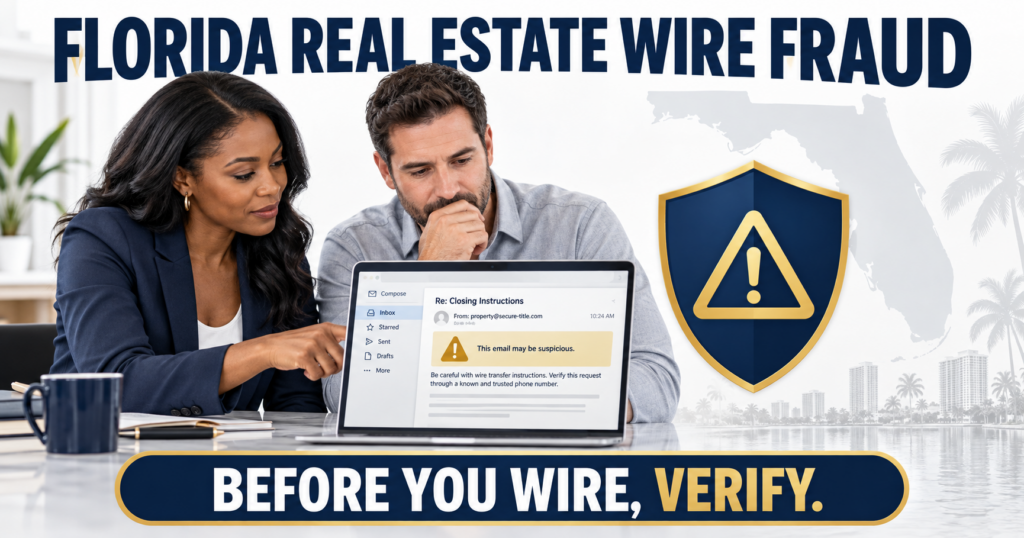
How to spot suspicious closing instructions and help buyers safeguard their funds
TL;DR: Real estate wire fraud can start with an email that looks like it came from a trusted closing professional. Help buyers establish a verification process early, confirm payment instructions through a trusted contact, and report suspected fraud immediately. These steps can reduce risk, but they cannot guarantee protection or recovery.
Your buyer is preparing for closing when an email arrives with new instructions for sending the down payment. The message uses familiar names and sounds urgent. Would your buyer know to stop and check it?
As a Florida real estate agent, you can make fraud awareness part of your transaction routine. Start the conversation before the buyer is under pressure to meet a closing deadline.
What Is Real Estate Wire Fraud?
Real estate wire fraud occurs when criminals trick someone into transferring transaction funds to an account they control. The FBI identifies a fake title-company message requesting a homebuyer’s down payment as an example of business email compromise. Criminals may imitate an email address or gain access to a legitimate account. See the FBI’s business email compromise guidance.
Consequently, a familiar sender name or a professional-looking message does not establish that a payment request is authentic.
Warning Signs Buyers Should Recognize
- Unexpected changes to the receiving account or payment process.
- Pressure to transfer money immediately.
- Small differences in an email address or website address.
- Instructions to use a new contact method for verification.
The first three signs align with FBI fraud-prevention guidance. The fourth is another reason to use an independently established contact. However, the absence of these signs does not prove that a message is safe.
Set Up Verification Before Closing
The CFPB recommends identifying trusted closing contacts and recording their phone numbers in advance. Before sending funds, buyers should confirm the instructions, including the account name and number, in person or through the previously established number. They should avoid using contact details or links supplied in a suspicious email. Read the CFPB’s mortgage closing scam guidance.
For your transaction checklist, consider adding a reminder when the closing provider is selected. Ask the buyer to save the verified contact information and explain whom to call with payment questions. Follow your brokerage’s procedures and coordinate with the settlement professional.
You can explain it this way: “Before you transfer closing funds, contact the closing office using the number you established earlier. If any instructions change, pause and verify them directly.”
A Florida Closing Scenario
Illustrative scenario: Maya, a first-time buyer in Orlando, is scheduled to close on Friday. Thursday afternoon, she receives an email appearing to come from the title company. It includes her property address and requests that she send $68,000 to a replacement account within an hour.
The email says the original account is undergoing maintenance. A signature block provides a phone number for “immediate confirmation.” Maya calls you because she remembers your earlier conversation about payment changes.
You ask her to pause the transfer and contact the title office through the number she saved when the closing process began. You also notify your broker. In this example, the title office confirms that it did not issue the replacement instructions, and Maya avoids sending money to the fraudulent account.
Afterward, you document the report and the steps taken, following your brokerage’s process. You coordinate any scheduling questions with the closing office rather than assuming that the original timetable still works.
The lesson for your next transaction is practical: give buyers a clear verification plan while they still have time to understand it. Maya knew where to turn because the conversation happened before the suspicious email arrived.
Protect Your Own Transaction Communications
The FBI recommends multifactor authentication and caution with unexpected links and attachments. Apply those safeguards to the accounts you use for transactions. Review the FBI’s account-security recommendations.
In addition, ask your broker how suspected account compromise should be reported and which systems your firm approves for exchanging sensitive documents. Make those procedures part of your onboarding and transaction training.
What If the Buyer Has Already Sent Money?
- Contact the sending bank immediately and report the suspected fraudulent wire. Ask about a recall or reversal and coordination with the receiving bank.
- Report the incident to the FBI’s Internet Crime Complaint Center. Include the transaction and banking details requested in the complaint.
- Notify your broker and the closing professional so they can address the transaction and follow their incident procedures.
- Preserve the original messages, payment records, and related evidence.
The first two steps follow IC3’s business email compromise response guidance. IC3 also instructs complainants to retain supporting evidence; see its complaint FAQs. Do not wait for an online complaint response before contacting the bank. Recovery is uncertain, so avoid promising the buyer that the money will be returned.
Build Fraud Awareness Into Your Brokerage Routine
Consider keeping a brief record of when you discussed wire fraud, who the buyer identified as the closing contact, and when you reminded the buyer to verify instructions. This makes the discussion easier to repeat consistently across transactions.
For related professional-development reading, explore Florida licensing, law, ethics, and compliance and the Florida sales associate post-license first-renewal guide.
Final Thoughts
Before your next closing, review the buyer’s verification plan with your broker and closing professional. A clear explanation early in the transaction gives the buyer a practical step to take when an unexpected payment request arrives.
Ready to take the next step?
Strengthen your real estate knowledge as you build your career. Explore online real estate courses at OLTraining.com.
Tags: Florida Real Estate, Real Estate Wire Fraud, Closing Safety, Buyer Protection, New Real Estate Agents, Business Email Compromise, Real Estate Education