
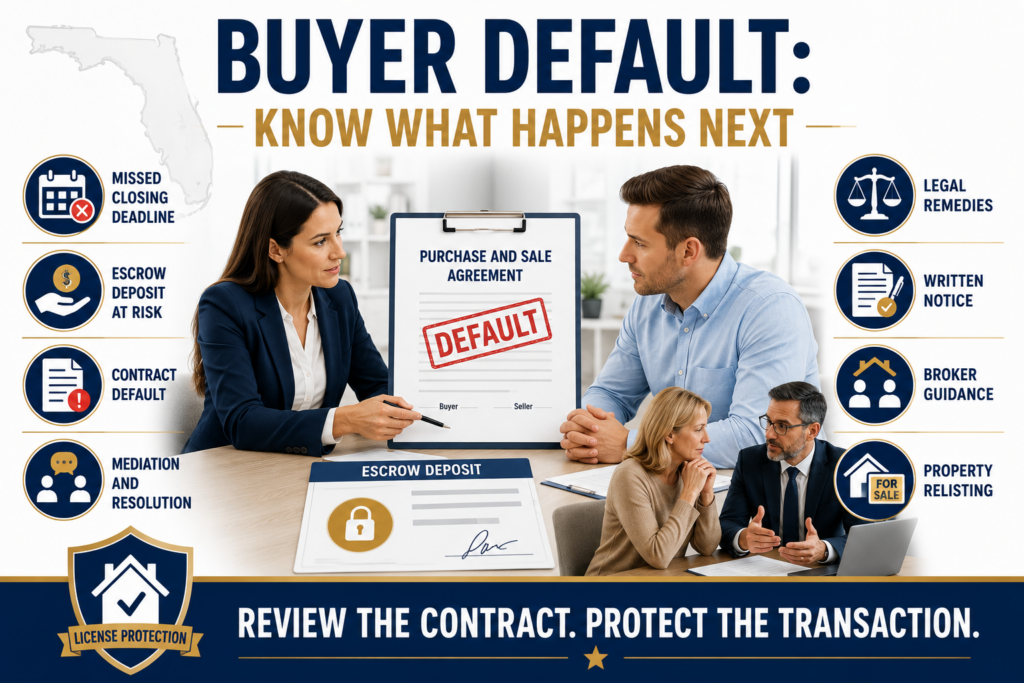
What new Florida real estate agents should know about Florida buyer contract breach, escrow deposits, seller remedies, and contract disputes.
TL;DR
A Florida buyer contract breach may occur when a buyer fails to perform a required contractual obligation without a valid right to cancel. Examples may include failing to deliver the deposit, failing to pursue financing as required, missing an important notice deadline, or refusing to close.
However, every failed transaction is not automatically a breach. A buyer may be entitled to cancel under an inspection provision, financing contingency, association-document review period, or another contractual or statutory right.
When a buyer defaults, the seller's remedies depend on the signed contract. The seller may be able to claim the deposit as liquidated damages, pursue another remedy authorized by the contract, negotiate a settlement, or seek legal action. The escrow holder cannot simply release a disputed deposit based on one party's demand.
What Is a Florida Buyer Contract Breach?
A real estate purchase contract creates legally enforceable obligations for both the buyer and the seller.
A Florida buyer contract breach occurs when the buyer fails, neglects, or refuses to perform a contractual obligation without a valid contractual or legal excuse.
Possible examples include:
- Failing to deliver the required escrow deposit
- Failing to apply for financing on time
- Failing to provide requested lender documents
- Failing to use diligent effort to obtain loan approval
- Missing a required notice deadline
- Refusing to sign required closing documents
- Failing to deliver closing funds
- Refusing to close after contractual contingencies have expired or been satisfied
Whether a particular action constitutes a breach depends on the exact language of the contract.
Therefore, agents should never declare that a buyer has defaulted without first reviewing the contract with their broker and recommending legal counsel when appropriate.
A Failed Closing Is Not Always a Buyer Breach
One of the most important lessons for new agents is that a canceled transaction does not automatically mean the buyer breached the contract.
A buyer may have a valid right to terminate.
Possible cancellation rights may arise from:
- An AS IS inspection provision
- A financing contingency
- An appraisal contingency or rider
- A title problem
- A seller default
- Condominium document review rights
- Homeowners' association disclosure rights
- Flood-disclosure requirements
- Lead-based paint provisions
- A property-specific rider
- Another contractual or statutory cancellation right
The buyer must still follow the contract's requirements.
That may include delivering written notice within a specified period, using good faith and diligent effort, or providing supporting documentation.
A buyer who had a valid cancellation right but failed to exercise it correctly may place the deposit at risk.
Florida Buyers Do Not Have an Automatic Three-Day Cancellation Right
A common misunderstanding is that a buyer can cancel any Florida residential purchase contract within three days after signing.
Florida residential contract forms do not provide an automatic three-day cancellation period simply because the buyer changed their mind.
A cancellation right must come from:
- The contract
- A rider or addendum
- A specific statute
- Mutual agreement between the parties
- Another recognized legal basis
Agents should not tell buyers that they have three days to cancel unless a specific provision applies.
The Contract Language Controls the Outcome
Florida has several residential contract forms, including:
- The Florida Realtors/Florida Bar AS IS Residential Contract
- The Florida Realtors/Florida Bar Residential Contract
- The Florida Realtors Contract for Residential Sale and Purchase
- Builder or developer contracts
- Attorney-prepared contracts
These forms do not contain identical default provisions.
Even different versions of the same form may contain revised language.
Before discussing the consequences of a Florida buyer contract breach, review:
- The contract form
- The form's revision date
- All riders and addenda
- Deposit provisions
- Financing terms
- Inspection terms
- Notice requirements
- Default provisions
- Dispute-resolution provisions
- Attorney-fee provisions
Never rely solely on what happened in a previous transaction.
What Happens to the Buyer's Escrow Deposit?
The earnest money deposit does not automatically belong to the seller merely because the transaction did not close.
First, the parties must determine:
- Whether the buyer breached
- Whether the buyer properly exercised a cancellation right
- Whether the seller performed the seller's obligations
- Whether another contingency remained available
- What the default clause permits
- Whether the parties agree on disbursement
If both parties sign matching written instructions, the escrow holder may disburse the deposit in accordance with those instructions.
If the buyer and seller make conflicting demands, the escrow holder must follow the applicable escrow procedures.
Can the Seller Keep the Deposit?
Under commonly used Florida residential contracts, a seller may be able to recover and retain the buyer's deposit as agreed-upon liquidated damages when the buyer defaults.
Choosing this remedy may resolve the seller's claims under the applicable default provision and release the parties from further contractual obligations.
However, this does not mean the listing agent or seller can immediately take the money.
If the buyer disputes the seller's entitlement to the deposit, the escrow holder must retain the funds until the dispute is resolved through:
- Agreement between the parties
- Mediation
- Arbitration, when authorized and agreed upon
- An Escrow Disbursement Order when a real estate broker holds the funds
- Interpleader
- A court order
- Another legally authorized procedure
The agent should never promise the seller that the deposit will automatically be released.
What Are Liquidated Damages?
Liquidated damages are an amount the parties agreed in advance would compensate the seller if the buyer defaults.
In many residential contracts, the liquidated-damages amount is tied to the buyer's deposit.
This remedy can give the seller a more predictable outcome without requiring the seller to prove the full amount of actual loss.
However, the seller should understand that electing liquidated damages may prevent the seller from pursuing other claims under the same default provision.
Because selecting a legal remedy can have serious consequences, the agent should recommend that the seller consult a Florida real estate attorney.
Can the Seller Pursue the Buyer for More Than the Deposit?
Possibly.
The answer depends on:
- The contract form
- The default clause
- The remedy selected by the seller
- The amount and type of damages
- Whether the seller was ready and able to perform
- Whether the buyer had a valid defense
- Florida law
Some contracts allow the seller to pursue equitable or other legal remedies rather than accepting the deposit as liquidated damages.
A seller may claim losses involving:
- A lower resale price
- Additional carrying costs
- Mortgage interest
- Taxes
- Insurance
- Association expenses
- Additional closing expenses
- Other transaction-related losses
Recoverability is a legal question.
The agent should document the situation but should not calculate damages or advise the seller which remedy to pursue.
Can a Seller Force the Buyer to Close?
In some circumstances, a seller may seek specific performance or another equitable remedy.
Specific performance asks a court to require a party to perform the contract rather than merely pay money damages.
Whether this remedy is available depends on the contract, the facts, the seller's performance, and applicable law.
Specific performance is not automatic. It usually requires legal action and may involve considerable time and expense.
A real estate agent should never tell a seller that the buyer can definitely be forced to purchase the property. That advice must come from an attorney.
What Happens When a Broker Holds the Deposit?
When a Florida real estate broker holds the escrow deposit and receives conflicting demands, the broker must follow Florida's escrow-dispute procedures.
The broker must provide written notice to the Florida Real Estate Commission within 15 business days after receiving the last party's demand.
The broker must also begin one of the authorized settlement procedures within 30 business days.
Those procedures may include:
- Requesting an Escrow Disbursement Order from FREC
- Arbitration with the consent of all parties
- Court adjudication through interpleader or another action
- Mediation with the written consent of all parties
A sales associate who learns of an escrow dispute should notify the employing broker immediately.
The sales associate should not decide who receives the deposit.
What Happens When a Title Company or Attorney Holds the Deposit?
The FREC Escrow Disbursement Order process applies to deposits held in a real estate broker's escrow account.
It does not apply in the same way when the deposit is held by:
- A title company
- A closing attorney
- Another authorized escrow agent
A title company or attorney may require matching written instructions from both parties before releasing disputed funds.
If the parties cannot agree, the escrow holder may file an interpleader action and ask a court to decide who is entitled to the money.
Agents should contact the escrow holder for its procedures but should not pressure the holder to release disputed funds.
Mediation May Be Required Before Litigation
Many Florida residential contracts contain a dispute-resolution process.
When the buyer and seller make conflicting deposit demands, the contract may give them a period to attempt to resolve the disagreement. If they do not reach a resolution, they may be required to attempt mediation before pursuing most court remedies.
Mediation allows a neutral mediator to help the parties negotiate a settlement.
Possible settlements may include:
- Returning the entire deposit to the buyer
- Releasing the entire deposit to the seller
- Dividing the deposit
- Reimbursing specific expenses
- Extending the contract
- Restructuring the transaction
- Releasing both parties from further obligations
The mediator does not decide the case. The parties must agree to the settlement.
Could the Buyer Be Responsible for Attorney's Fees?
Some Florida residential contracts contain prevailing-party attorney-fee provisions.
Under such a provision, the party who prevails in permitted litigation may be entitled to recover reasonable attorney's fees and costs from the other party.
This can make a deposit dispute much more expensive than the deposit itself.
Agents should not use the possibility of attorney's fees to threaten a party. Instead, the agent should recommend legal advice before the dispute escalates.
Can the Seller Put the Property Back on the Market?
An escrow dispute does not, by itself, prevent a seller from advertising or selling the property.
However, the seller must first determine whether the original contract has been properly terminated.
The release of the deposit and termination of the purchase contract are related issues, but they are not always the same issue.
Before relisting or accepting another offer, the seller should obtain guidance from:
- The listing broker
- The closing agent
- A Florida real estate attorney
Relisting too early could create overlapping contractual obligations or additional disputes.
Common Causes of Florida Buyer Contract Breach
Failure to Deliver the Deposit
If the contract requires the buyer to deliver a deposit by a specified deadline, failing to do so may constitute default.
The contract may still be enforceable even if the initial deposit was not delivered, depending on its wording.
Therefore, agents should immediately alert the broker rather than assuming the contract is automatically canceled.
Failure to Pursue Financing
A financing contingency does not allow the buyer to stop cooperating with the lender.
The buyer may be required to:
- Apply on time
- Pay application and appraisal fees
- Provide requested financial documents
- Respond to lender requests
- Use good faith and diligent effort
- Deliver required notices before deadlines
A buyer who causes the loan to fail may lose the protection of the financing contingency.
Missing a Cancellation Deadline
A buyer may have the right to cancel during an inspection or financing period.
However, if the buyer fails to deliver proper notice before the deadline, that right may expire.
Silence is not always the same as cancellation.
Refusing to Close
A buyer who simply changes their mind after contingencies have expired may face a Florida buyer contract breach claim.
Reasons such as cold feet, concern about future prices, or finding another preferred property may not provide a contractual right to terminate.
Failing to Deliver Closing Funds
A buyer who does not deliver the required funds by the closing deadline may be in default unless another contract provision excuses performance.
Agents should also determine whether the closing date was properly extended under the contract's time-calculation provisions.
What Should the Buyer's Agent Do?
When a buyer says they no longer want to close, the buyer's agent should not immediately send a cancellation form without reviewing the situation.
Instead:
- Ask the buyer why they want to cancel.
- Review the contract and all riders.
- Identify any applicable deadline or contingency.
- Notify the employing broker.
- Document the buyer's instructions.
- Avoid guaranteeing the return of the deposit.
- Recommend legal counsel when the buyer's rights are unclear.
- Deliver notices promptly when authorized by the buyer.
- Keep copies of every notice and communication.
Speed matters because a valid cancellation right can expire.
What Should the Listing Agent Do?
When the buyer appears unwilling or unable to close, the listing agent should:
- Notify the listing broker.
- Review the exact contract language.
- Document all communications.
- Avoid declaring the buyer in default.
- Avoid promising that the seller will receive the deposit.
- Ask the seller to obtain legal advice about remedies.
- Coordinate with the escrow holder.
- Use approved release and cancellation forms.
- Confirm the contract's status before relisting.
- Continue presenting offers as required by law and brokerage policy.
The listing agent's role is to communicate and facilitate – not to decide the legal dispute.
What Agents Should Never Say
Avoid statements such as:
- The seller automatically gets the deposit.
- You can cancel for any reason.
- The contract is already dead.
- The buyer has three days to change their mind.
- The title company has to release the money.
- The seller can sue for everything.
- The buyer will definitely lose in court.
- We can relist immediately.
- Just stop responding.
- Do not worry about the deadline.
These statements may be legally incorrect and could increase the brokerage's exposure.
Can the Parties Still Save the Transaction?
A potential breach does not always end the deal.
The parties may agree to:
- Extend the closing date
- Extend the financing period
- Change the loan type
- Increase the deposit
- Modify the purchase price
- Provide a seller credit
- Resolve an appraisal issue
- Complete repairs
- Change the closing agent
- Enter a short-term occupancy agreement
- Sign another written modification
Any change should be placed in writing and signed by the parties.
An extension of the closing date does not automatically extend every other contract deadline. The amendment should identify each period being changed.
Why Documentation Matters
Contract disputes often depend on what the parties did, when they did it, and whether notice was delivered properly.
Important records may include:
- The executed contract
- Riders and addenda
- Deposit receipts
- Financing applications
- Lender communications
- Inspection notices
- Cancellation notices
- Extension requests
- Emails
- Text messages
- Transaction notes
- Escrow demands
- Release forms
- Proof of delivery
Good records help the broker, escrow holder, mediator, and attorneys understand what occurred.
Continue Learning
You may also find these resources helpful:
- AS IS vs. Standard Florida Residential Contract
- Florida Real Estate Disclosures: Complete Guide
- Can a Florida Real Estate Agent Be Personally Sued?
- Florida Real Estate Exam vs. Real-World Practice
Final Thoughts
A Florida buyer contract breach can create financial losses, escrow disputes, delays, and possible litigation.
However, the first question should not be, "Who gets the deposit?"
The first questions should be:
- What does the signed contract require?
- Did the buyer have a valid cancellation right?
- Was notice delivered correctly and on time?
- Did the seller satisfy the seller's obligations?
- Which default remedy does the contract provide?
- Who is holding the deposit?
- What dispute-resolution procedure applies?
New agents protect their customers and their licenses by slowing down, reviewing the contract, notifying the broker, documenting every step, and recommending legal counsel when the parties' rights are disputed.
Ready to Take the Next Step?
Continue building your Florida real estate knowledge with professional licensing, exam preparation, post-licensing, and continuing education courses.
Explore Florida real estate courses at OLTraining
Educational Notice
Educational Notice: This article provides educational information and is not legal advice. Contract rights and remedies depend on the signed agreement and the facts of the transaction. Buyers, sellers, and licensees should consult a Florida real estate attorney when legal rights are disputed.
Tags: Florida Buyer Contract Breach, Buyer Default Florida Real Estate, Florida Escrow Deposit Dispute, Florida Real Estate Contract, Earnest Money Deposit Florida, Buyer Failure to Close, Florida Real Estate Agents, Real Estate Contract Default