
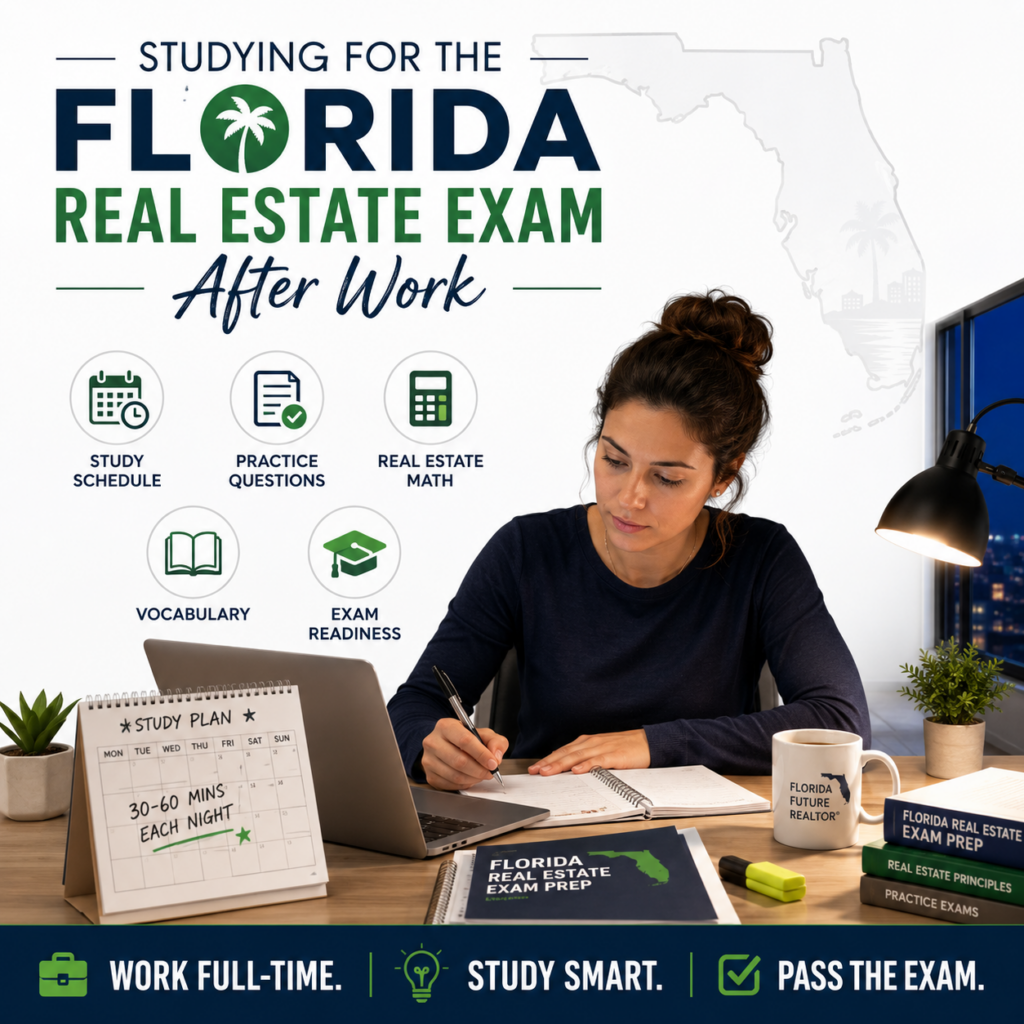
A practical study plan for busy Florida real estate students who need to pass the exam without quitting their job.
TL;DR
Studying for the Florida real estate exam while working full-time is possible, but it requires a realistic schedule, a focused study system, and consistent review. Instead of waiting for large blocks of free time, successful students use short daily study sessions, weekend review blocks, practice questions, and a clear plan for exam readiness. The key is to study smarter, not longer.
Why Full-Time Workers Need a Different Study Strategy
Many Florida real estate students are not full-time students. They are working professionals, parents, caregivers, business owners, or people trying to transition into a new career while still protecting their current income. As a result, they cannot always study for several hours at a time.
However, that does not mean they are at a disadvantage. In fact, students who work full-time often bring discipline, organization, and real-world experience to the learning process. The challenge is not motivation. The challenge is time management.
Therefore, your study plan should not be based on the idea that you will suddenly find extra time. Instead, it should be built around the time you actually have: early mornings, lunch breaks, evenings, weekends, and small pockets of quiet time during the week.
Start With a Realistic Weekly Study Calendar
The first step is to create a weekly study calendar that fits your real life. Do not begin with the question, “How many hours should I study?” Instead, begin with, “When can I consistently study without burning out?”
For many full-time workers, a practical schedule may look like this:
Monday through Thursday: 30 to 45 minutes of focused study each evening
Friday: Light review or a break
Saturday: 90 to 120 minutes of deeper review and practice questions
Sunday: 60 to 90 minutes of exam review, vocabulary, and weak-area correction
This type of schedule can create five to seven hours of quality study time each week without requiring you to give up your job or overload every evening. More importantly, it creates consistency.
Break the Course Into Smaller Study Goals
One of the biggest mistakes students make is trying to study too much at once. After a full workday, your brain may not be ready to absorb long chapters, legal definitions, formulas, and practice questions all in one sitting.
Instead, break your course into smaller goals. For example, one study session might focus only on brokerage relationships. Another session might focus only on real estate math. A third session might focus only on license law or contracts.
This approach helps you make progress even when your energy is limited. In addition, small goals are easier to complete, which keeps you motivated throughout the course.
Use Short Study Sessions During the Workweek
When you work full-time, short study sessions are often more effective than long, exhausting sessions. A focused 35-minute session after dinner can be more valuable than a three-hour session where you are tired, distracted, and frustrated.
During the week, use short sessions for tasks such as reviewing vocabulary, reading one course section, watching one lesson segment, completing a small quiz, or reviewing missed questions. Then, save longer practice exams and heavier review for the weekend.
As a result, you keep moving forward without making the process feel impossible.
Study the Exam the Way It Is Tested
The Florida real estate exam does not simply test whether you recognize words. It tests whether you understand how concepts apply in real situations. Therefore, your study plan should include more than reading and highlighting.
To prepare effectively, combine three study methods: read the course material, summarize the concept in your own words, and answer practice questions that test the same topic. If you miss a question, do not just memorize the correct answer. Go back and identify why your answer was wrong.
This is especially important for topics such as agency, brokerage relationships, disclosure duties, contracts, financing, property ownership, valuation, and real estate math. These areas require understanding, not just memorization.
Make Real Estate Vocabulary Part of Your Daily Routine
Real estate vocabulary is one of the biggest obstacles for new students. Terms such as encumbrance, fiduciary, consideration, easement, variance, escrow, novation, and transaction broker can feel unfamiliar at first.
However, the words become easier when you see them repeatedly. Therefore, create a small daily vocabulary habit. Review five to ten terms each day. Say the definition out loud. Then, connect the term to a simple example.
For instance, do not only memorize that an easement is a right to use another person’s property for a specific purpose. Also picture a driveway easement, utility easement, or access easement. The example helps the definition stay in your memory.
Protect Your Energy and Avoid Burnout
Working full-time and studying for a licensing exam can become overwhelming if you try to do everything at maximum speed. Therefore, you need a plan that protects your energy.
First, schedule at least one lighter study day each week. Second, avoid studying when you are so tired that you are only rereading the same page without understanding it. Third, use weekends for deeper review, but do not turn every weekend into an all-day study marathon.
In other words, passing the exam is the goal, but sustainability matters. A steady student who studies consistently for several weeks is usually better prepared than a student who crams intensely for a few days and then burns out.
Use Practice Questions the Right Way
Practice questions are powerful, but only if you use them correctly. Many students answer practice questions too quickly and then move on without reviewing their mistakes. That is a missed opportunity.
After each practice set, review every missed question and ask yourself three questions: Did I misunderstand the concept? Did I miss a key word in the question? Did I guess because I did not know the rule?
Then, write a short correction note. For example: “Transaction brokers provide limited representation but are not fiduciaries in the same way single agents are.” A correction note helps turn a missed question into a learning moment.
Create a Weekend Exam Readiness Routine
Because weekdays are often busy, weekends should be used for exam readiness. This does not mean you need to study all day. Instead, create a structured weekend routine.
A good weekend routine may include reviewing one major topic area, completing a timed practice quiz, correcting missed questions, reviewing real estate math formulas, and updating your list of weak areas.
Over time, this gives you a clear picture of whether you are improving. It also helps you avoid the common mistake of repeatedly reviewing the topics you already like while ignoring the topics that need more work.
Prioritize Real Estate Math Early
Many students wait too long to practice real estate math. That can make math feel more stressful than it needs to be. Instead, begin reviewing math early and practice it in small amounts throughout the course.
Focus on the common types of real estate calculations, including commissions, prorations, property taxes, interest, loan-to-value ratios, area measurements, and basic valuation problems. Then, practice each type until you understand the process step by step.
Most importantly, do not simply memorize formulas. Learn when to use each formula and what the answer means in a real estate transaction.
Turn Your Commute and Breaks Into Review Time
If your workday is packed, look for small moments that can support your study plan. For example, you may be able to review vocabulary during lunch, listen to course-related audio during a commute, or review flashcards before starting your evening routine.
These short review moments should not replace focused study time. However, they can reinforce what you already learned and help keep real estate concepts fresh in your mind.
Small review habits are especially useful for students who feel disconnected from the course during the workweek. Even ten minutes of review can help you stay engaged.
Know When You Are Ready to Schedule the Exam
Do not schedule the exam based only on finishing the course. Finishing the course is important, but exam readiness requires more. Before scheduling, you should be able to explain major concepts, answer practice questions consistently, complete timed quizzes without panic, and identify your weak areas.
In addition, review the official exam information provided through Florida’s licensing resources and Pearson VUE scheduling process. The Florida Department of Business and Professional Regulation explains that the sales associate examination is administered through Pearson VUE, and the Candidate Information Booklet is designed to help candidates understand the examination process.
Once your practice scores are consistent and your weak areas are improving, you can schedule with more confidence.
Sample 4-Week Study Plan for Full-Time Workers
Here is a simple four-week structure that can help you organize your review after completing or nearing completion of the course.
Week 1: Review license law, FREC rules, licensure requirements, and brokerage relationships.
Week 2: Review property rights, ownership, contracts, agency duties, and disclosures.
Week 3: Review financing, appraisal, real estate math, closing costs, and prorations.
Week 4: Complete timed practice questions, correct weak areas, review vocabulary, and take a final readiness check.
Of course, every student is different. If your schedule is tighter, stretch the plan over six or eight weeks. The important point is to create a plan that you can actually follow.
Common Mistakes to Avoid
First, do not rely only on reading. Reading is important, but you also need active review and practice questions.
Second, do not wait until the end to study math. Real estate math becomes easier with repeated practice.
Third, do not study only when you feel motivated. Motivation changes, but a written schedule keeps you moving.
Finally, do not isolate yourself when you are confused. Ask questions, use instructor support, and get clarification before a small misunderstanding becomes a larger problem.
Why the Right Course Support Matters
A strong study plan matters, but support also matters. When you are working full-time, you may not have time to search endlessly for answers when a concept does not make sense.
That is why responsive instructor support can make a major difference. Students need to know they are not alone. They need help understanding difficult topics, staying encouraged, and preparing for the exam with confidence.
At OLTraining.com, students can study online while still having access to real guidance. That combination is especially valuable for busy adults who are balancing work, family, and career goals.
Ready to take the next step? Visit OLTraining.com real estate courses and explore the course options available to help you move forward.
Final Thoughts
Studying for the Florida real estate exam while working full-time is not easy, but it is absolutely manageable with the right plan. Start with a realistic schedule, study in small consistent blocks, review vocabulary daily, practice questions regularly, and use weekends for deeper review.
Most importantly, remember that progress does not require perfection. It requires consistency. If you keep showing up, correcting mistakes, and building your understanding one topic at a time, you can prepare for the Florida real estate exam while still managing your full-time responsibilities.
Tags
Florida Real Estate Exam, Florida Real Estate License, Real Estate Exam Study Tips, Study While Working Full-Time, Florida Real Estate Course, Real Estate Pre-License, Florida Sales Associate Exam, Real Estate Math, Exam Prep, OLTraining