
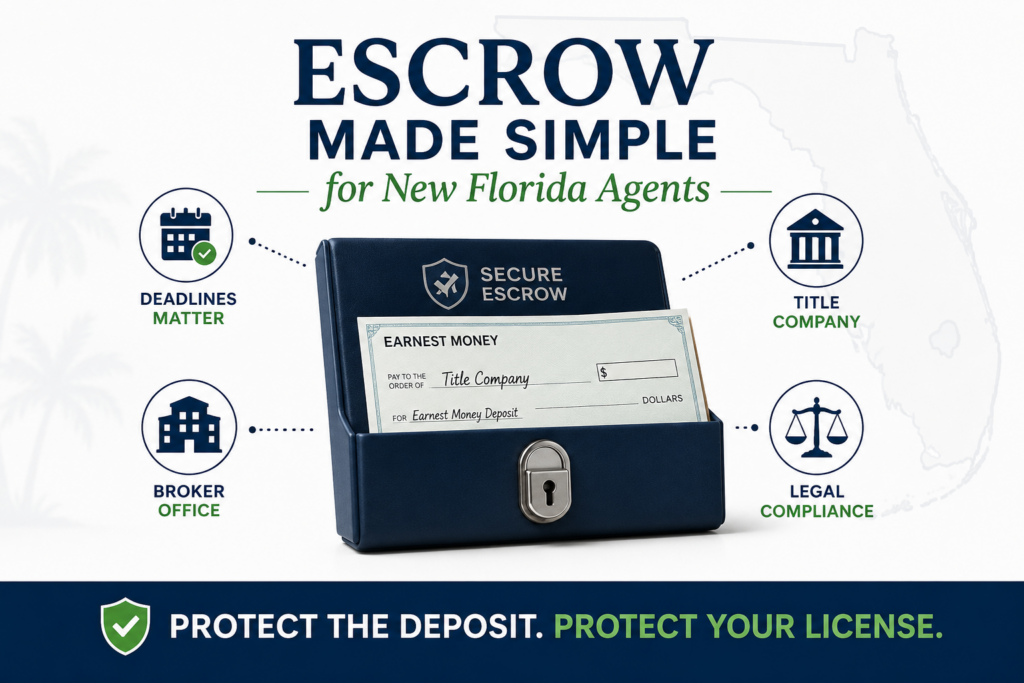
A simple guide to deposits, deadlines, disputes, and license protection for new Florida real estate agents
TL;DR
Florida escrow rules are designed to protect consumers, brokers, and licensees. New sales associates should remember one simple rule: when you receive a deposit, do not hold it. Deliver it to your broker or employer no later than the end of the next business day. From there, the broker must place escrow funds into an approved escrow or trust account within the required time frame. When in doubt, ask your broker before acting.
Why Escrow Handling Matters in Florida Real Estate
Escrow handling is one of the most important compliance responsibilities in a Florida real estate transaction. Although a new sales associate may not manage the brokerage escrow account, the associate can still create a serious problem by delaying, mishandling, or misunderstanding a deposit.
In simple terms, escrow money is money or another item of value that is held for the parties until the transaction reaches the point where the funds can be properly disbursed. In a sales transaction, this is often the buyer’s earnest money deposit. However, escrow can also involve other funds connected with a real estate transaction.
Because escrow funds belong to someone else, Florida law treats them differently from ordinary business money. Therefore, every new sales associate should understand the basic deadlines and know when to involve the broker immediately.
What Is an Escrow Deposit?
An escrow deposit is money, a check, or another acceptable item of value delivered in connection with a real estate transaction. Most new agents encounter escrow in the form of an earnest money deposit from a buyer.
The purpose of the deposit is usually to show the buyer’s good faith and to support the terms of the purchase contract. Even so, the sales associate should not decide where the money ultimately goes if the transaction later fails. That decision must follow the contract, the parties’ written instructions, or the legal settlement procedures required under Florida law.
The Sales Associate’s Main Rule: Do Not Hold the Deposit
For a new sales associate, the most important escrow rule is easy to remember: once you receive a deposit, get it to your broker or employer on time.
Florida Administrative Code Rule 61J2-14.009 requires a sales associate who receives a deposit to deliver it to the broker or employer no later than the end of the next business day after receiving the item. Saturdays, Sundays, and legal holidays are not counted as business days.
As a practical matter, that means a sales associate should never keep a deposit in a desk drawer, car, purse, briefcase, or personal account. Instead, the associate should follow the brokerage’s written procedure immediately.
The Broker’s Deposit Deadline
After the broker receives escrow funds, the broker must place the funds into an approved escrow or trust account. Florida rules define “immediately” as no later than the end of the third business day following receipt of the item to be deposited.
This timing matters because receipt by a sales associate or other representative of the brokerage counts as receipt by the broker for purposes of the broker’s escrow deposit deadline. Therefore, a delay by the sales associate can also create a compliance problem for the broker.
Where Escrow Funds May Be Held
Escrow funds are not simply placed wherever the agent or customer prefers. They must be held in an approved escrow or trust arrangement, such as an account with a qualified bank, trust company, credit union, savings association, title company with trust powers, or another permitted holder located and doing business in Florida.
Sometimes the contract names a title company or attorney as the escrow holder. When that happens, the contract should clearly identify the escrow holder, including the name, address, and telephone number. This helps prevent confusion later and gives all parties a clear record of where the deposit is supposed to go.
Do Not Commingle Escrow Funds
Commingling occurs when escrow funds are mixed with personal or brokerage operating funds. Florida rules strictly limit this practice because escrow money does not belong to the broker or sales associate.
A broker may keep a limited amount of personal or brokerage funds in an escrow account only for account-maintenance purposes. The general limit is up to $1,000 in a sales escrow account and up to $5,000 in a property management escrow account. For a new sales associate, the safer takeaway is simple: never place escrow money into a personal account and never treat deposit money as brokerage operating money.
What Happens If the Deal Falls Apart?
Escrow becomes more complicated when a transaction does not close. For example, the buyer may want the deposit returned, while the seller may believe the buyer defaulted and should forfeit the deposit. This creates what Florida law calls conflicting demands.
When conflicting demands or a good-faith doubt exists, the broker should not simply pick a side. Instead, the broker must follow the required notice and settlement procedures. These may include requesting an Escrow Disbursement Order from FREC, using arbitration with the consent of all parties, asking a court to decide through interpleader or another court process, or using mediation with written consent of all parties.
New sales associates should avoid giving legal opinions about who is entitled to the money. Instead, they should notify the broker immediately and let the broker handle the dispute according to Florida law and brokerage policy.
Common Escrow Mistakes New Agents Should Avoid
Many escrow problems begin with small mistakes. For example, an associate may forget to tell the broker a deposit was received, delay turning in a check, fail to document a wire confirmation, or assume that a title company received funds without verification.
Another common mistake is trying to be helpful by telling one party that the deposit “will definitely” be returned or forfeited. Although the agent may want to reassure the customer, escrow disputes must be handled carefully. Therefore, it is better to explain that the broker will review the contract and follow the required procedure.
Best Practices for New Sales Associates
- Use your brokerage’s escrow checklist every time.
- Confirm who is holding the escrow deposit before the contract is signed.
- Turn over checks and deposit information immediately.
- Keep written records of when the deposit was received and delivered.
- Never deposit escrow funds into a personal account.
- Never promise a buyer or seller who will receive disputed escrow funds.
- Ask your broker before answering escrow questions you are unsure about.
How Escrow Rules Protect Your License
Escrow violations can lead to complaints, discipline, fines, and damage to a new agent’s reputation. More importantly, mishandling escrow funds can harm consumers who trusted the brokerage to protect their money.
The good news is that most escrow problems are preventable. With clear communication, quick action, accurate records, and broker guidance, new sales associates can handle escrow situations professionally and confidently.
Continue Learning
- Florida Real Estate Commission (FREC) Explained
- The Most Common Mistakes New Florida Real Estate Agents Make
- How to Get a Florida Real Estate License
Ready to take the next step?
Start your Florida real estate education with OLTraining.com and build the confidence to handle real estate transactions the right way.
Visit OLTraining.com Real Estate
Final Thoughts
Escrow handling may seem intimidating at first, but the basic rule for new sales associates is straightforward: act quickly, document carefully, and involve your broker immediately. When escrow funds are handled properly, everyone in the transaction is better protected.
By learning Florida escrow rules early, new sales associates can avoid costly mistakes, protect their license, and develop professional habits that support a successful real estate career.
Tags: Florida Real Estate Escrow, Escrow Handling Florida, New Sales Associates, Florida Real Estate License, FREC Rules, Real Estate Compliance, Earnest Money Deposit, Florida Real Estate Education