
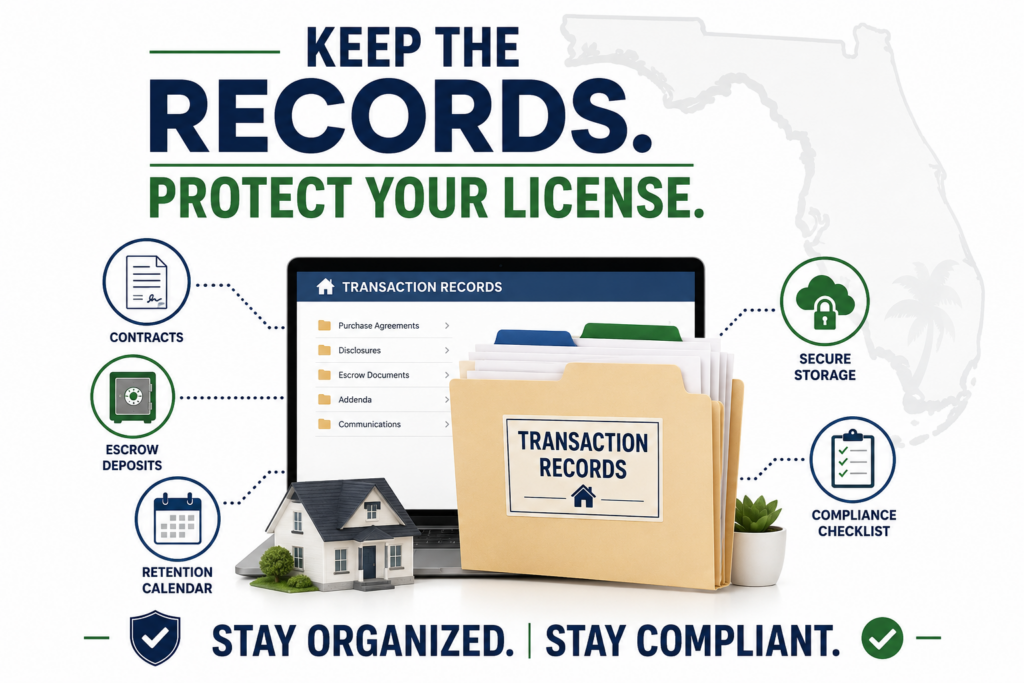
What Florida agents and brokers should know about keeping transaction files, escrow records, and disclosure documents organized and compliant
TL;DR
Florida real estate recordkeeping rules help protect consumers, brokers, sales associates, and the integrity of each transaction. In Florida, brokers must keep legible copies of brokerage business records for at least five years. In addition, escrow records, disclosure documents, contracts, leases, property management agreements, and related transaction records should be organized, accurate, and easy to retrieve if the DBPR or FREC requests them.
Why Recordkeeping Matters in Florida Real Estate
Good recordkeeping is not just an office habit. It is an important part of Florida real estate compliance.
Real estate transactions create a long paper trail. Listings, offers, counteroffers, escrow receipts, agency disclosures, emails, addenda, leases, and property management agreements may all become important later. Therefore, agents who keep accurate records help protect their customers, their broker, and their own real estate license.
In addition, organized records make it easier to answer questions, resolve misunderstandings, respond to complaints, and prove that the transaction was handled properly.
The Basic Rule: Keep Records for at Least Five Years
Florida law requires each broker to keep and make available books, accounts, and records that allow the Department of Business and Professional Regulation to determine whether the broker is complying with Chapter 475, Florida Statutes.
The key number to remember is five years.
A broker must preserve at least one legible copy of brokerage business records for at least five years from the date the broker receives money, funds, deposits, checks, or drafts entrusted to the broker.
If no funds are entrusted to the broker, the five-year period generally begins from the date any party executes a listing agreement, offer to purchase, rental property management agreement, rental or lease agreement, or another written or verbal agreement that engages the broker’s services.
What If a Record Is Involved in Litigation?
Sometimes, a transaction file becomes part of a lawsuit or other civil action. When that happens, the recordkeeping period may be longer.
If a brokerage record has been the subject of litigation or has served as evidence in litigation, the relevant books, accounts, and records must be retained for at least two years after the civil action or appeal concludes, whichever is later. However, the total retention period cannot be less than five years.
As a result, brokers and agents should be careful before deleting old files simply because five years have passed. If the file is connected to litigation, the safer approach is to confirm the retention requirement before disposing of anything.
What Records Should Be Kept?
Although every brokerage may have its own file checklist, common records include:
- Listing agreements
- Buyer brokerage agreements, when used
- Offers, counteroffers, contracts, and addenda
- Leases and rental agreements
- Rental property management agreements
- Brokerage relationship disclosures
- No brokerage relationship notices, when required
- Escrow receipts and deposit documentation
- Deposit slips and bank statements for escrow accounts
- Email, text, or written communication related to important transaction instructions
- Closing statements and transaction correspondence
- Advertising approvals and compliance records, when applicable
The goal is simple: if someone later asks what happened in the transaction, the file should tell the story clearly.
Sales Associates: Your Broker Is Responsible, But You Still Matter
Florida’s recordkeeping statute focuses on the broker, but sales associates play a major role in keeping files complete.
A sales associate should not assume that a verbal conversation, a text message, or a signed document is unimportant. Instead, the associate should promptly provide transaction documents to the broker or office file system according to brokerage policy.
In practice, this means agents should submit paperwork quickly, follow the broker’s document checklist, and avoid keeping important records only on a personal phone, laptop, or email account.
Escrow Records Require Extra Care
Escrow records deserve special attention because they involve money that belongs to others.
When a broker receives a deposit, the broker must preserve and make available deposit slips, account statements from the depository, agreements between the parties, and accurate records for each deposit transaction and each separate bank account where funds are held.
In addition, a broker with a trust account must prepare a monthly written reconciliation comparing the broker’s total trust liability with the reconciled bank balance of all trust accounts. The broker must review, sign, and date the monthly reconciliation statement.
Because escrow mistakes can lead to serious discipline, new agents should ask their broker immediately if they are unsure how to handle a deposit or related document.
Digital Records Are Acceptable Only If They Are Reliable
Many brokerages now use digital transaction management systems. That can be a great advantage, but only if the records are complete, legible, backed up, and easy to retrieve.
For example, a scanned contract should be readable. A saved email should include the relevant context. A text message used to confirm an instruction should be preserved in a way that the brokerage can access later.
Therefore, digital recordkeeping should not be casual. It should be organized, secure, and consistent.
Best Practices for Florida Real Estate Agents
New agents can reduce recordkeeping problems by following a few simple habits:
- Submit documents to the broker as soon as possible
- Use the brokerage’s transaction checklist
- Keep communication professional and easy to document
- Avoid storing the only copy of an important document on a personal device
- Save signed disclosures and contract addenda in the correct file
- Ask the broker before deleting or discarding any transaction record
- Review escrow instructions carefully
- Keep records organized by transaction, property address, and client name
Most recordkeeping problems are preventable. However, prevention requires a system.
Common Recordkeeping Mistakes to Avoid
Even experienced agents can make recordkeeping mistakes when they are busy. However, small habits can create big problems later.
Common mistakes include failing to upload a signed addendum, saving important texts only on a personal phone, forgetting to document delivery of disclosures, failing to preserve escrow-related records, or assuming that a closed transaction no longer matters.
In addition, agents should be careful with advertising, brokerage relationship disclosures, and property management records. These areas often require documentation that proves the agent followed the rules.
How Florida Real Estate Recordkeeping Rules Protects Your License
Good records help tell the truth when memories fade.
If a customer files a complaint months or years after closing, the transaction file may be the best evidence of what actually happened. Complete records can show that disclosures were delivered, offers were presented, escrow was handled properly, and communication was professional.
On the other hand, missing records can make a simple misunderstanding look like a compliance problem. For that reason, recordkeeping should be treated as part of risk management.
Continue Learning
You may also find these resources helpful:
- Florida Real Estate Commission (FREC) Explained
- florida-real-estate-advertising-rules
- The Most Common Mistakes New Florida Real Estate Agents Make
Ready to Take the Next Step?
Visit OLTraining.com Real Estate Courses to learn more about Florida real estate education and exam preparation resources.Final Thoughts on Florida Real Estate Recordkeeping Rules
Recordkeeping may not be the most exciting part of real estate, but it is one of the most important. Florida agents who develop strong recordkeeping habits early are better prepared to serve customers, support their broker, and protect their license.
In short, good records create confidence. They help prove what happened, when it happened, and how the transaction was handled.
Tags
Florida Real Estate Recordkeeping, Florida Real Estate Compliance, FREC Rules, Chapter 475 Florida Statutes, Real Estate Broker Records, Escrow Records Florida, Florida Real Estate Agents, Transaction Files, Real Estate License Protection