
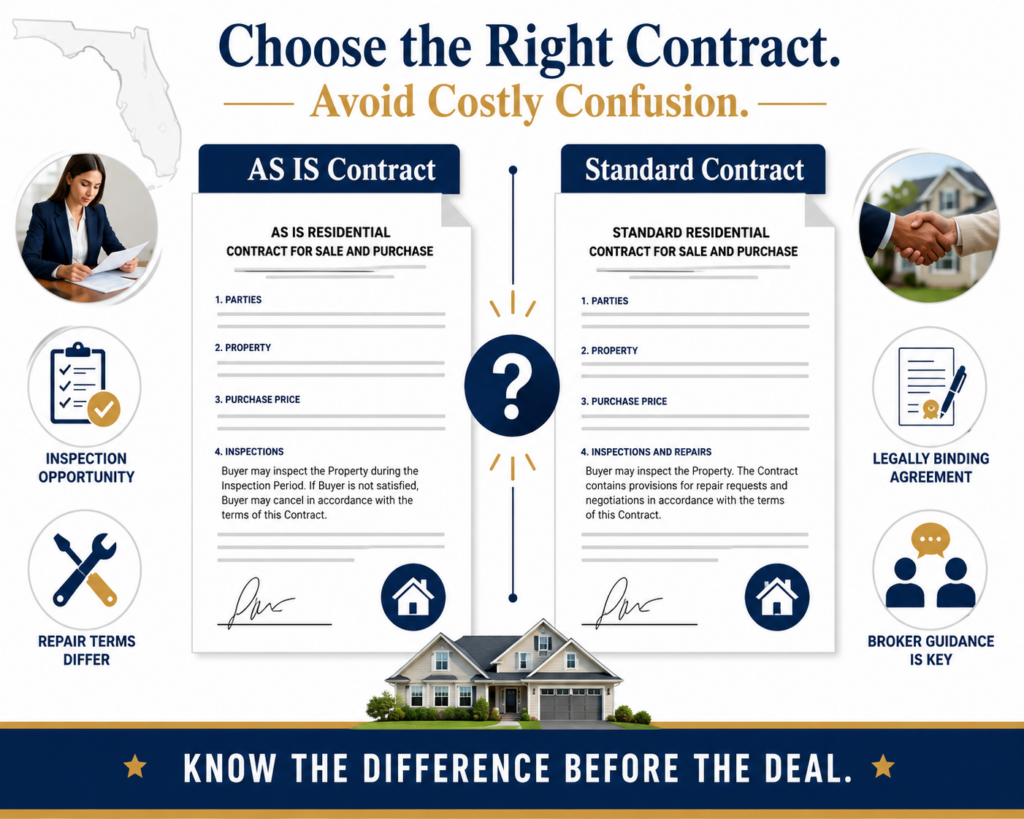
Subtitle:The differences between the AS IS vs Standard Florida Residential Contract is an eye openner for most licensees. Understanding the differences between Florida’s two most commonly used residential contracts can help new agents avoid confusion and better serve their customers.
TL;DR
One of the biggest surprises for new licensees is that Florida has two commonly used residential purchase contracts: the AS IS Residential Contract for Sale and Purchase and the Standard Residential Contract for Sale and Purchase. You will learn about AS IS vs Standard Florida Residential Contract and see that while the contracts are very similar, they differ significantly in how repairs are handled. Understanding these differences helps new agents communicate more effectively, avoid common mistakes, and work more confidently with buyers, sellers, and their brokers.
Why New Agents Often Confuse These Contracts
Many students spend considerable time learning contract law while preparing for the Florida real estate exam.
However, after becoming licensed, they quickly discover that understanding how contracts work in actual transactions is very different from simply answering exam questions.
One of the most common areas of confusion involves the AS IS vs. Standard Florida Residential Contract.
Both contracts are widely used throughout Florida.
Both are legally binding agreements.
Both contain many of the same sections.
Yet one important difference changes how inspections and repairs are handled.
Understanding that difference is essential for every new Florida real estate agent.
What the Two Contracts Have in Common
Before discussing the differences, it helps to understand what these contracts share.
Both contracts generally include provisions addressing:
- Purchase price
- Financing
- Closing date
- Earnest money deposit
- Title evidence
- Property condition disclosures
- Closing costs
- Default provisions
- Risk of loss
- Possession
Because much of the language is similar, new agents sometimes assume the contracts function exactly the same.
They do not.
The Biggest Difference: Repairs
The primary distinction between the two contracts involves repairs.
AS IS Residential Contract
The AS IS contract allows the buyer to conduct inspections during the inspection period.
If the buyer is dissatisfied with the property’s condition, the buyer generally has the option to cancel the contract within the inspection period, subject to the terms of the contract.
Importantly, the seller is generally not obligated to make repairs simply because the buyer requests them.
Of course, the parties remain free to negotiate repairs or credits if both sides agree.
Standard Residential Contract
The Standard Residential Contract approaches repairs differently.
Rather than simply accepting the property “as is,” the contract contains provisions that address how certain repairs may be requested and negotiated, subject to the contract’s terms and any applicable repair limits.
The specific obligations always depend on the language contained in the current version of the contract.
For that reason, agents should carefully review the contract being used and consult their broker whenever questions arise.
What “AS IS” Really Means
One of the biggest misconceptions among new agents is believing that “AS IS” means:
- The buyer cannot inspect the property.
- The buyer cannot negotiate repairs.
- The seller never has to negotiate.
None of those assumptions is necessarily true.
An AS IS contract still allows buyers to conduct inspections according to the terms of the agreement.
If inspection issues arise, buyers and sellers often negotiate repairs, price reductions, credits, or other solutions.
The contract simply changes how those negotiations begin.
Why Sellers Often Prefer the AS IS Contract
Many Florida sellers prefer the AS IS contract because it creates greater certainty regarding repair obligations.
Advantages may include:
- Fewer repair disputes
- Simpler negotiations
- Faster contract preparation
- Clearer expectations
However, this does not mean an AS IS contract is always the best choice.
Every transaction is unique.
Why Buyers May Still Choose an AS IS Contract
Some new agents assume buyers should avoid AS IS contracts.
In reality, many buyers are comfortable using them because they still receive an inspection opportunity.
If inspections reveal concerns, buyers may:
- Continue with the purchase
- Request repairs or credits
- Negotiate a different purchase price
- Cancel the contract during the inspection period if permitted by the contract
This flexibility is one reason the AS IS contract is commonly used throughout Florida.
Common Mistakes New Agents Make
Assuming “AS IS” Means No Negotiations
Repairs and credits can still be negotiated.
Many successful transactions involve agreements reached after inspections.
Giving Legal Advice
Agents should explain contract provisions based on their training but should avoid interpreting legal rights or providing legal advice.
When legal questions arise, encourage customers to consult an attorney.
Using the Wrong Contract
New agents should never choose a contract simply because they have used it before.
The appropriate contract depends on the transaction and should always be selected in accordance with brokerage policies and broker guidance.
Failing to Read the Entire Contract
Both contracts contain many important deadlines and obligations.
Reading only the inspection section is not enough.
Successful agents become familiar with every section of the contract they use.
Why Broker Guidance Is So Important
Every brokerage has procedures for preparing offers and selecting contract forms.
Your broker is one of your most valuable resources when learning:
- Which contract is appropriate
- Current contract revisions
- Brokerage policies
- Best practices for presenting offers
As a new agent, asking questions early can prevent expensive mistakes later.
Tips for New Florida Real Estate Agents
When working with either contract:
- Read every page carefully.
- Know your important deadlines.
- Explain contract provisions accurately.
- Never guess if you are uncertain.
- Consult your broker whenever questions arise.
- Recommend legal counsel when legal advice is requested.
These habits help protect both your customers and your real estate license.
Continue Learning
Understanding Florida contracts is only one part of becoming a successful real estate professional.
You may also find these resources helpful:
- Florida Real Estate Exam vs. Real-World Practice
- Can a Florida Real Estate Agent Be Personally Sued?
- Advertising Rules in Florida Real Estate
- The Most Common Mistakes New Florida Real Estate Agents Make
Final Thoughts
The difference between the AS IS vs. Standard Florida Residential Contract is one of the first practical lessons many new agents encounter after becoming licensed.
Although the two contracts look similar, they handle repairs differently and can affect how inspections and negotiations unfold.
The more familiar you become with Florida contracts, the more confidently you can assist buyers and sellers while staying within your role as a licensed real estate professional.
Remember, successful agents never stop learning.
They continue studying contracts, asking questions, and working closely with their brokers to provide excellent service throughout every transaction.
Ready to Take the Next Step?
Build your confidence with Florida real estate training designed to help you succeed both on the state exam and in real-world practice.
Tags: AS IS Florida Contract, Standard Florida Residential Contract, Florida Real Estate Contracts, Florida Real Estate Forms, New Florida Real Estate Agents, Florida Residential Purchase Contract, Florida Real Estate Training