
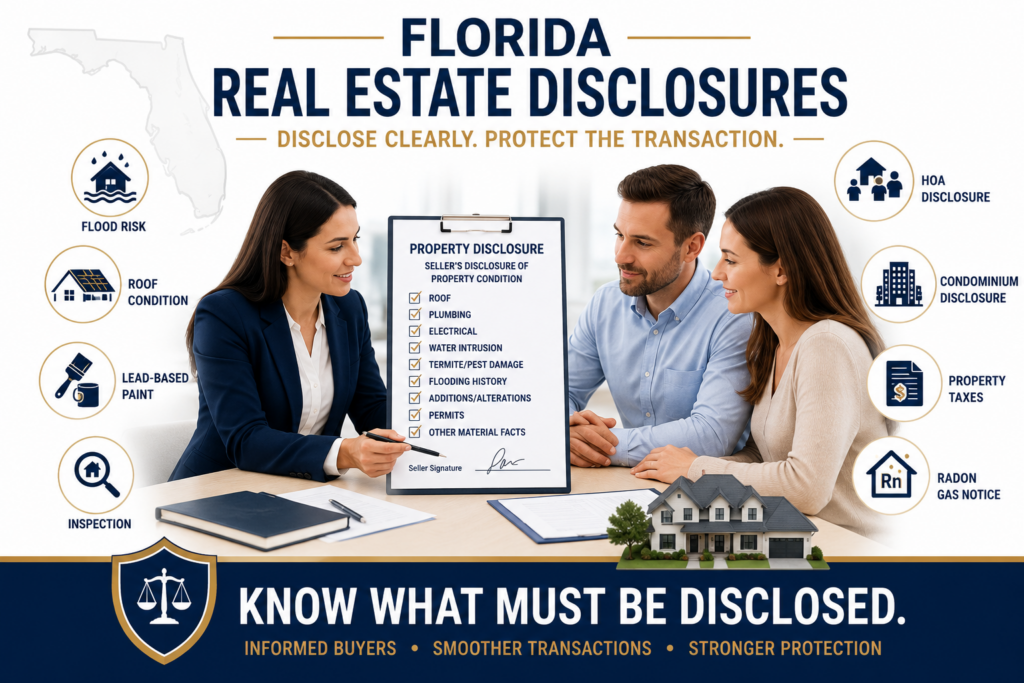
What Florida real estate agents, sellers, and buyers should understand before entering a residential transaction
TL;DR
Florida real estate disclosures help buyers make informed decisions and protect sellers and real estate professionals from avoidable disputes. Florida sellers must disclose known facts that materially affect the value of residential property when those facts are not readily observable or already known to the buyer.
In addition, certain properties require specific notices involving flood history, homeowners’ associations, condominiums, property taxes, radon gas, lead-based paint, coastal regulations, sewer laterals, subsurface rights, and other matters. Not every disclosure applies to every transaction, which is why agents must review the property, the transaction, current forms, and brokerage procedures carefully.
Why Florida Real Estate Disclosures Matter
Disclosure requirements are designed to help buyers understand important facts before becoming legally committed to a purchase.
They also help sellers avoid allegations that they concealed a serious condition.
For real estate agents, disclosure compliance is an essential part of risk management. Missing a required form, overlooking a known defect, or failing to deliver a document on time can result in:
- Contract cancellation
- Delayed closings
- Deposit disputes
- Complaints against the licensee
- Brokerage liability
- Civil lawsuits
- Damage to professional reputations
Therefore, disclosures should never be treated as routine paperwork.
Each disclosure serves a specific purpose, and some must be delivered before or at the time the sales contract is executed.
The Basic Florida Seller Disclosure Rule
Florida’s central residential disclosure rule comes from the Florida Supreme Court decision in Johnson v. Davis.
Under this rule, a residential seller must disclose facts when all of the following apply:
- The seller knows about the fact or condition.
- The fact materially affects the property’s value.
- The condition is not readily observable.
- The buyer does not already know about it.
This obligation can apply even when the property is being sold under an AS IS contract.
An AS IS contract may limit a seller’s contractual repair obligations, but it does not give the seller permission to conceal known, hidden material defects.
What Is a Material Fact?
A material fact is information significant enough that it could affect a reasonable buyer’s decision to purchase the property, negotiate different terms, or investigate further.
Possible examples include known, concealed issues involving:
- Repeated roof leaks
- Structural movement or foundation damage
- Serious water intrusion
- Prior flooding
- Unrepaired fire damage
- Defective plumbing or electrical systems
- Termite or wood-destroying organism damage
- Unpermitted additions
- Defective sewer connections
- Sinkhole activity
- Major mold conditions
- Boundary or access problems
- Conditions affecting the property’s lawful use
Not every minor maintenance issue automatically becomes a material fact.
However, when a seller or agent is uncertain, the safest approach is to consult the broker and recommend that the seller obtain legal guidance when necessary.
Is a Written Seller Disclosure Form Required?
Florida real estate transactions often use a written seller property disclosure form.
A written form is valuable because it:
- Organizes information by property system
- Creates a record of what the seller disclosed
- Helps buyers identify areas requiring inspection
- Reduces misunderstandings
- Helps agents document the transaction
However, completing a form should not be treated as a substitute for honest and complete disclosure.
If the seller becomes aware of a new material condition after completing the form, the seller may need to update the disclosure.
Likewise, checking “unknown” does not protect a seller who actually knows about a serious problem.
Common Florida Real Estate Disclosures
Not every transaction requires every disclosure listed below. The correct disclosures depend on the property’s age, location, ownership type, condition, association status, and other facts.
Seller’s Property Disclosure
The seller’s property disclosure commonly addresses:
- Roof age and condition
- Plumbing
- Electrical systems
- Heating and cooling
- Appliances
- Structural conditions
- Water intrusion
- Insurance claims
- Termites and pests
- Pools and spas
- Septic systems and wells
- Additions and alterations
- Permits
- Environmental conditions
- Boundary concerns
- Association membership
The seller should answer based on actual knowledge rather than guessing.
The agent should not complete the form for the seller or tell the seller how to answer factual questions.
Florida Flood Disclosure Requirements
Flood risk has become one of the most important Florida real estate disclosures.
A seller of residential property must provide the required flood disclosure at or before the time the sales contract is executed.
The disclosure addresses whether the seller:
- Knows of flooding that damaged the property during the seller’s ownership
- Filed an insurance claim related to flood damage
- Received federal or other assistance for flood damage
The notice also explains that a standard homeowners’ insurance policy does not include flood-damage coverage.
Agents should not assume that a property outside a high-risk flood zone has never flooded. Heavy rainfall, drainage failures, tidal conditions, and standing water can affect properties in many locations.
Buyers should be encouraged to speak with:
- Their insurance agent
- A qualified home inspector
- A surveyor
- Local floodplain officials
- Other appropriate specialists
Lead-Based Paint Disclosure
Federal lead-based paint disclosure requirements apply to most residential housing constructed before 1978.
Before the buyer becomes obligated under the contract, the seller and agents must complete the required disclosure process.
This may include:
- Disclosing known lead-based paint and lead hazards
- Providing available reports and records
- Giving the buyer the federal lead-hazard information pamphlet
- Including the required lead warning statement
- Providing the buyer an opportunity to conduct a lead inspection or risk assessment
Agents have responsibilities under the federal rule and should use current approved forms.
The lead-based paint disclosure is separate from the seller’s regular property disclosure.
Radon Gas Notice
Florida law requires a radon gas notice to appear on at least one document, form, or application executed at or before the contract for the sale and purchase of a building.
The notice explains that:
- Radon is a naturally occurring radioactive gas.
- High concentrations may create health risks.
- Elevated levels have been found in Florida buildings.
- Additional information is available through county health departments.
The notice does not state that the property has elevated radon levels.
Instead, it advises the parties of the possible risk and the availability of testing.
Property Tax Disclosure
A buyer should not assume that the seller’s current property tax bill will remain the same after closing.
Florida requires a residential property tax disclosure informing buyers that:
- A change in ownership can trigger reassessment.
- Property improvements may also affect assessed value.
- The buyer’s future taxes could be higher than the seller’s current taxes.
This disclosure is commonly included in an approved residential sales contract.
Agents should avoid estimating future taxes unless they have reliable information and should direct buyers to the appropriate county property appraiser.
Homeowners’ Association Disclosure
When property is located in a community requiring membership in a homeowners’ association, the buyer must receive the statutory homeowners’ association disclosure summary before executing the contract.
The disclosure addresses topics such as:
- Mandatory association membership
- Recorded restrictive covenants
- Regular assessments
- Special assessments
- Possible liens for unpaid assessments
- Fees for recreational or common facilities
- The importance of reviewing governing documents
If the disclosure is not provided at the required time, the buyer may have a limited statutory cancellation right.
Because timing matters, agents should verify association status early and use the current disclosure summary.
Condominium Disclosures
Condominium transactions involve additional documents and disclosure requirements.
Depending on whether the transaction is a developer sale or a resale, a buyer may be entitled to receive documents such as:
- Declaration of condominium
- Articles of incorporation
- Bylaws
- Association rules
- Annual financial statement
- Current budget
- Frequently Asked Questions and Answers document
- Governance form
- Milestone inspection information
- Structural integrity reserve study
- Turnover inspection reports, when applicable
Condominium contracts must also contain specific statutory language.
Buyer cancellation periods and document-delivery requirements can differ depending on the type of transaction and the documents involved.
New agents should never rely on memory when calculating a condominium cancellation period. Review the current contract, statutes, brokerage procedures, and broker instructions.
Cooperative Property Disclosures
Florida cooperative transactions are governed by a separate statutory framework.
Cooperative buyers may be entitled to documents such as:
- Articles of incorporation
- Bylaws
- Association rules
- Financial information
- Question-and-answer documents
- Structural inspection information, when applicable
- Reserve study information, when applicable
Developer sales and resales may have different disclosure language and cancellation periods.
Because condominium and cooperative ownership are not the same, agents should use the form and disclosure package designed for the correct ownership type.
Community Development District Disclosure
A Community Development District, commonly called a CDD, may impose taxes or assessments to pay for infrastructure, operations, and community services.
For an initial sale of property within a CDD, the contract must contain the required disclosure language informing the buyer that the district may impose taxes or assessments in addition to other governmental taxes and assessments.
Agents should also help buyers recognize that CDD charges may appear on the property tax bill.
However, agents should not describe a CDD charge as ending on a particular date without verifying the district records.
Sanitary Sewer Lateral Disclosure
A sanitary sewer lateral is the privately owned pipe connecting a property to the public sewer main.
Before executing a sales contract, a seller must disclose known defects in the property’s sanitary sewer lateral.
Possible defects may involve:
- Cracked pipes
- Root intrusion
- Collapsed lines
- Repeated backups
- Improper connections
- Known repair requirements
A standard home inspection may not include a sewer camera inspection.
Therefore, buyers concerned about the condition of the line may wish to hire a qualified plumbing or sewer professional.
Subsurface Rights Disclosure
A special disclosure may be required when certain subsurface rights have been or will be severed or retained in connection with qualifying residential property.
Subsurface rights may include rights involving:
- Oil
- Gas
- Minerals
- Phosphate
- Metals
- Other underground resources
The disclosure warns buyers that another party may hold rights to underground resources and, in some circumstances, rights of entry or extraction.
Agents should refer title and legal questions to the title professional or attorney handling the transaction.
Coastal Property Disclosure
Property located partially or entirely seaward of Florida’s coastal construction control line requires a special written disclosure.
The notice warns buyers that the property may be affected by:
- Coastal erosion
- Beach fluctuations
- Construction restrictions
- Beach nourishment programs
- Regulations involving shoreline protection
- Sea turtle protection requirements
Additional survey or affidavit requirements may also apply before closing unless properly waived.
Coastal property rules are specialized, so agents should work closely with their broker, title professional, surveyor, and other appropriate experts.
Solar Panels, PACE Assessments, and Special Financing
Solar systems and energy improvements may create additional disclosure and due-diligence concerns.
Agents should determine whether the system is:
- Owned outright
- Subject to a loan
- Leased
- Covered by a power purchase agreement
- Connected to a recorded lien or UCC filing
- Financed through a property assessment program
A buyer may need to qualify to assume an agreement, pay off an obligation, or obtain approval from the provider.
Agents should not promise that a solar agreement will transfer automatically.
Instead, obtain the relevant documents and direct the parties to the lender, provider, title professional, or attorney.
Permits, Code Violations, and Unapproved Improvements
Known permit problems, code violations, or unapproved improvements may materially affect a property.
Common examples include:
- Enclosed garages
- Converted porches
- Room additions
- Pools
- Roof replacements
- Electrical work
- Plumbing alterations
- Accessory structures
Agents should avoid telling buyers that unpermitted work is acceptable simply because it has existed for many years.
Buyers may face:
- Correction costs
- Permit expenses
- Insurance problems
- Financing difficulties
- Removal requirements
- Resale complications
When concerns arise, the buyer should investigate with the appropriate local government and qualified professionals.
What Florida Sellers Do Not Have to Disclose
Florida law identifies certain facts that are not treated as material facts requiring disclosure.
For example, a seller or agent is not required to disclose that:
- An occupant has or had HIV or AIDS.
- The property was the site of a homicide, suicide, or death.
However, licensees should still avoid making false statements if directly asked a question.
When a question creates uncertainty about confidentiality, disclosure obligations, or fair housing concerns, consult the broker before responding.
Brokerage Relationship Disclosures
Property-condition disclosures are not the only disclosures involved in a Florida transaction.
Depending on the brokerage relationship, the licensee may also need to provide notices involving:
- Single-agent representation
- Transition from single agent to transaction broker
- No brokerage relationship
- Designated sales associates in qualifying nonresidential transactions
Agents should understand which notices apply, when they must be delivered, and how the brokerage documents the relationship.
The Agent’s Role in Florida Real Estate Disclosures
An agent’s role is not to inspect the property or provide legal conclusions.
Instead, an agent should:
- Explain the purpose of disclosure forms
- Deliver required forms and documents on time
- Disclose known, hidden material facts
- Avoid concealing or minimizing known defects
- Encourage inspections and professional evaluations
- Maintain organized transaction records
- Follow broker instructions
- Use current approved forms
- Refer legal questions to an attorney
Agents should never tell a seller to omit an issue because the buyer “probably will not notice.”
Likewise, an agent should not make repairs sound minor without reliable professional support.
What Buyers Should Do With Disclosures
Disclosures provide information, but they are not warranties and do not replace inspections.
Buyers should:
- Read every disclosure carefully.
- Compare disclosures with inspection findings.
- Ask questions about unclear responses.
- Obtain specialized inspections when necessary.
- Review association documents.
- Investigate insurance availability and cost.
- Review flood, permit, and tax information.
- Consult attorneys, inspectors, engineers, surveyors, and other experts when appropriate.
A disclosure stating that the seller has no knowledge of a condition does not prove that the condition does not exist.
Florida Real Estate Disclosures Checklist
Before a contract is executed, agents should determine whether the transaction may require:
- Seller’s property disclosure
- Flood disclosure
- Lead-based paint disclosure
- Radon notice
- Property tax disclosure
- HOA disclosure summary
- Condominium documents
- Cooperative documents
- CDD disclosure
- Coastal property disclosure
- Sanitary sewer lateral disclosure
- Subsurface rights disclosure
- Solar or assessment documents
- Brokerage relationship notice
- Other property-specific forms
After contract execution, agents should track:
- Document delivery
- Buyer acknowledgments
- Cancellation deadlines
- Inspection periods
- Updated seller disclosures
- Association responses
- Title and survey issues
- Required signatures and initials
Common Disclosure Mistakes New Agents Make
Waiting Until the Last Minute
Some disclosures must be delivered before or when the contract is executed.
Waiting until closing may be too late.
Assuming the Contract Includes Everything
Approved contracts contain many notices, but a separate form or document package may still be required.
Treating “AS IS” as “No Disclosure”
An AS IS contract does not authorize concealment of known, hidden material facts.
Completing the Seller’s Form
The seller should provide the factual answers. The agent may explain the form but should not answer on the seller’s behalf.
Making Unsupported Statements
Avoid statements such as:
- “The roof is fine.”
- “The property has never flooded.”
- “The addition is legal.”
- “Insurance will not be a problem.”
- “That assessment will disappear soon.”
Verify information or identify its source.
Final Thoughts
Understanding Florida real estate disclosures is one of the most important risk-management skills a new agent can develop.
The key is recognizing that there is no single form that addresses every possible property and transaction.
Instead, you must evaluate:
- What the seller knows
- What the buyer already knows
- Whether the fact materially affects value
- Whether the issue is readily observable
- What type of property is being sold
- Where the property is located
- Which statutes and forms apply
- When each disclosure must be delivered
When you use current forms, document communications, work closely with your broker, and recommend qualified professional guidance, you help protect the parties, your brokerage, and your license.
Continue Learning
You may also find these resources helpful:
- AS IS vs. Standard Florida Residential Contract
- Can a Florida Real Estate Agent Be Personally Sued?
- Florida Real Estate Exam vs. Real-World Practice
- Advertising Rules in Florida Real Estate
Ready to Take the Next Step?
Continue building your Florida real estate knowledge with professional licensing, exam preparation, post-licensing, and continuing education courses.
Explore Florida real estate courses at OLTraining
Educational Notice: This article provides educational information and is not legal advice. Disclosure requirements can change and may depend on the property and transaction. Licensees should use current forms, follow brokerage procedures, and recommend legal counsel when appropriate.
Tags: Florida Real Estate Disclosures, Florida Seller Disclosure, Florida Flood Disclosure, HOA Disclosure Florida, Condominium Disclosure Florida, Lead-Based Paint Disclosure, Florida Real Estate Law, Seller Property Disclosure, Florida Real Estate Agents